


When Paul VandeGraaf presented his 2025 annual report to the Cobourg Police Services Board (March 24, 2026), the message was clear: the Cobourg Police Service is accountable, transparent, and trusted.
It was a confident message. It was also a carefully constructed one.
But in communities like Cobourg, trust is not built through messaging. It is built through consistent, visible action—and that is where the gap continues to grow.
From the outset, the Chief described the report as more than a summary of activity. He framed it as a reflection of how the service has adapted to increasing demands, legislative changes, and evolving public expectations, all while remaining grounded in core values.
Those are the right words.
The issue is whether they reflect reality.
For over a year, questions have gone unanswered. Not complex policy questions—but direct, reasonable inquiries from residents and business owners looking for clarity. At the same time, there have been notable absences of communication around incidents that many would reasonably expect police to address publicly.
Transparency is not selective. It does not apply only when it is convenient or when the optics are favourable.
In 2025, there were multiple suspicious fires in Cobourg’s downtown core. These were not minor events—they were incidents that raised concern within the community. Yet there no communication from the police service. In the Chief’s own report, only two arson investigations are acknowledged, neither of which were solved and it’s unknown if they were the fires downtown.
Silence in situations like these does not reassure the public—it creates uncertainty.
The same pattern appears elsewhere. A pedestrian was struck in January 2026.. No public release. Reports of shoplifting arrests at a local grocery store. Again, no communication. Meanwhile, smaller or less consequential incidents have, at times, been shared publicly.
This inconsistency undermines credibility. It raises a simple question: what determines whether the public is informed? Or, what else isn’t being released?
If the answer is not clear, then trust begins to erode.
To be clear, this is not a criticism of frontline officers. They respond to calls, handle difficult situations, and serve the community daily. The concern lies at the leadership level—specifically in how decisions are made about communication, engagement, and accountability.
Leadership sets the tone.
And tone matters.
Throughout the presentation, there was repeated emphasis on “strong partnerships,” “evidence-based decision making,” and “community safety priorities.” These are standard phrases in modern policing, and they sound reassuring. But without visible follow-through, they risk becoming little more than rhetoric.
There is also a broader issue of connection to the community.
Chief VandeGraaf does not live in Cobourg and has spent most of his tenure residing outside the town. That fact alone is not disqualifying. However, it does raise an important consideration: how deeply can someone understand a community they are not fully immersed in?
Cobourg is not defined by statistics in an annual report. It is defined by lived experience—by the concerns of residents, the challenges facing downtown businesses, and the day-to-day realities that don’t always make it into official data.
Being present matters.
Community events, for example, are not simply ceremonial. They are opportunities for leadership to engage, to listen, and to be visible. The recent Polar Plunge fundraiser, which brought together police and emergency services from across the region in support of Special Olympics, is one such example. While Port Hope Police Chief Tim Farquharson, took part, Cobourg’s leadership was notably absent. (The event raised nearly $20,000 for Special Olympics)
These moments may seem small, but they contribute to a larger perception.
And perception matters.
It is shaped not only by what is said, but by what is seen.
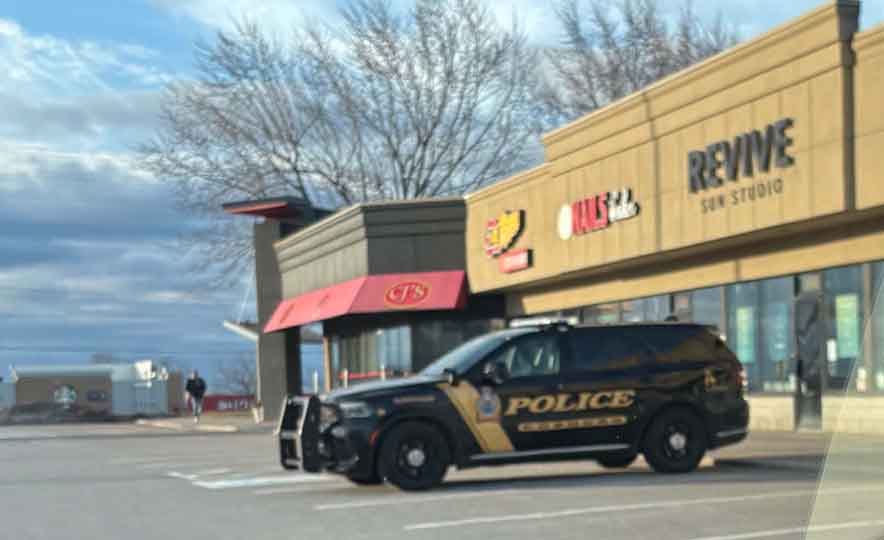
Even operational optics play a role. Today’s Northumberland was sent two images that showed multiple police cruisers gathered at a single location near a restaurant, questions arise— not because officers are not entitled to breaks, but because the public expects visibility and coverage in the town they serve.
There were four police cruisers parked at the side of a building and one parked in front. It appears they were on a break. The four cruisers may not have wanted to be noticed and parked at the side of the building. Whey they having a break? Who knows.
Without communication, even routine situations can be interpreted negatively.
This is the cost of limited transparency: the public fills in the gaps.
The Chief also addressed an increase in complaints in 2025, noting that 18 were filed and suggesting this reflects greater awareness and accessibility rather than a decline in professionalism.
That may be partially true.
But complaints should not be explained away so quickly. They are a form of feedback. They represent moments where members of the public felt something was not right. Dismissing them as a byproduct of awareness risks overlooking underlying issues that deserve attention.
Accountability requires more than acknowledgment—it requires reflection and response.
At the conclusion of the report, the Chief stated that when “everything else” is stripped away, Cobourg has a service that any municipality would be proud of. He also emphasized that the service operates with “full transparency and full accountability.”
These are strong statements.
But they invite scrutiny.
Because if transparency is full, why are there unanswered questions?
If accountability is complete, why do concerns appear to go unaddressed?
If public trust is strong, why do so many continue to question it?
These are not rhetorical questions. They are the kinds of questions that define the relationship between a police service and the community it serves.
Trust is not built in annual reports. It is built over time—through openness, consistency, and a willingness to engage, even when the questions are uncomfortable.
Right now, there is a growing perception in Cobourg that the words being spoken do not fully align with the actions being taken.
That perception may not reflect the entire reality of the service—but it is a reality nonetheless.
And ignoring it will not make it go away.
If the Cobourg Police Service wants to strengthen public trust, it does not need better messaging. It needs better engagement. It needs consistency in communication. It needs to show—not just say—that accountability and transparency are more than guiding principles.
They are daily practices.
Because in the end, the community is not asking for perfection.
It is asking for honesty.
And that is where trust begins.
Update on New Police Chief
There was also a update on the search for a new police Chief.
A representative from Waterhouse Executive stated to the Police Services Board there are five candidates on a “recommend list,” and six to seven on a “b-list” and the “c-list” is a “fyi list,” adding, “they applied no reason to consider them.”

Author: Pete Fisher
Has been a photojournalist for over 30-years and have been honoured to win numerous awards for photography and writing over the years. Best selling author for the book Highway of Heroes - True Patriot Love