
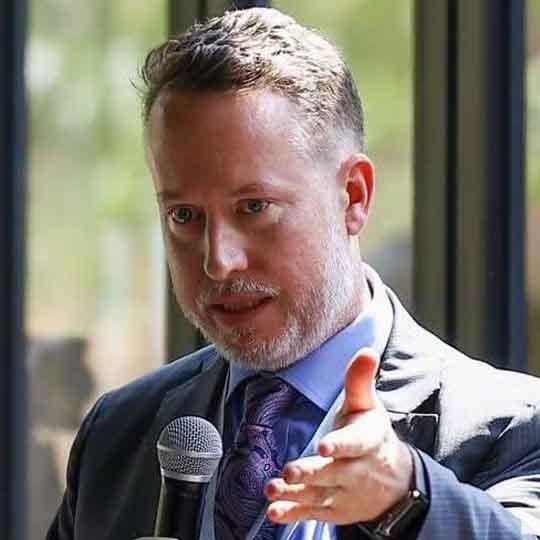
Hope is fading for a former resident of Cobourg imprisoned in Dubai who fears extradition to South Sudan could ultimately cost him his life.
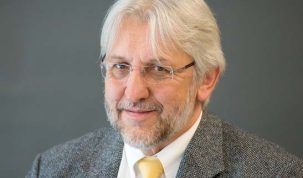
Ryan O’Grady, a 47-year-old Canadian banker and former CEO of Kush Bank, has been held in custody in the United Arab Emirates since November 2025 after being arrested at his home in Dubai.
O’Grady, who was born and raised in Cobourg, says he has now come to believe his extradition to South Sudan is inevitable despite objections from the Canadian government and mounting concerns about his safety, medical condition and legal rights.
Speaking through his wife, Virginia, O’Grady told Today’s Northumberland he believes he has been targeted after attempting to expose financial irregularities while working in South Sudan’s banking sector.
He served as CEO of Kush Bank between 2022 and 2023 after being recruited to help stabilize and clean up the institution’s finances.
According to O’Grady, his work eventually placed him in direct conflict with powerful individuals and networks within South Sudan.
“When I refused their extortion attempts they decided they would misuse Interpol after a 19-month investigation to drag me back to face their version of what I call ‘jungle justice.’”
O’Grady left South Sudan and moved to Dubai in 2024 after receiving what he described as escalating death threats.
Prior to his arrest, O’Grady said he believed he had finally found peace and stability after years working internationally in difficult environments.
“I was in fact living my dream in every way,” he said.
“In personal and professional life I truly felt like I was making an impact on the world.”
“My career was always focused on helping others. Reaching the role as CEO of the bank and the CEO of my own investment company was the height of my career.”
That changed abruptly in November 2025 when authorities in Dubai arrested him at his residence based on an Interpol notice issued at the request of South Sudan.
Since then, O’Grady has remained incarcerated at Al Awir Central Prison in Dubai while fighting extradition proceedings he says violate both due process and basic legal protections.
“The extradition trial itself was a sham,” he said.
“There is no extradition treaty between the UAE and South Sudan, yet the court ruled based on the principle of reciprocity.”
O’Grady says throughout his detention he has faced severe restrictions and little access to legal representation.
“In six months I have seen my embassy twice. In six months I have never once been able to speak directly to my lawyer.”
He says prison conditions have also taken a major toll on his physical health.
“It took five-and-a-half months to be examined by a doctor. It took almost six months to receive medication.”
“And even to do that I had to collapse unconscious and not breathing before I was finally taken to a clinic.”
O’Grady said the charge he faces in South Sudan — breach of trust of a public official — is completely unfounded.
“Every step I took at that bank was governed by Board resolution,” he said.
“Every transaction was reviewed by internal and external audit. Every transaction in a bank has to be executed by no less than three separate people.”
He believes the allegations are politically and financially motivated and fears returning to South Sudan would place him at extreme risk.
During his time in the country, O’Grady said both he and his wife were subjected to intimidation, threats and violence.
“I saw my wife abducted and detained by national security,” he said.
“The same agency tried to follow her into our home and do God knows what to her.”
“They attacked us publicly at the airport and attempted to stop us from leaving the country.”
O’Grady also claims there was another attack against him before he fled to Dubai.
“These people planned an attack at an event and it was only through the rapid actions of British and diplomatic security that I received life-saving treatment and was evacuated to Dubai.”
Now facing possible extradition, O’Grady says he fears not only torture or abuse, but also neglect within South Sudan’s detention system.
He urged people to research reports of deaths involving detainees extradited or imprisoned there.
“That does not count the many, many more who have died due to neglect or lack of medical access when they are there.”
“So while I hope I am not a victim of torture or abuse, I feel the risk is just as high that due to neglect and lack of access to medical intervention one or the other will take my life before any verdict is purchased by this cartel in South Sudan.”
Despite the uncertainty surrounding his future, O’Grady says he continues to hope he will eventually return to Canada alive.
“I pray that I do,” he said quietly.
“But I don’t know that I will.”
The Canadian government says it is aware of the case and has formally opposed O’Grady’s extradition.
Ruth Marrocco, assistant to Philip Lawrence, confirmed that Global Affairs Canada has been actively engaged in the matter.
According to a statement provided to Today’s Northumberland, Global Affairs Canada said O’Grady is being extradited pursuant to an Interpol notice issued at the request of South Sudan.
“Canada has formally expressed its opposition to Mr. O’Grady’s extradition to South Sudan, including through diplomatic engagement with senior United Arab Emirates officials,” the statement read.
“Canada has consistently raised concerns related to due process, fair trial guarantees, and the risk of mistreatment.”
The federal department added that following the recent court ruling, Canada has sought further engagement with UAE authorities and requested additional consular access to O’Grady.
Officials also indicated Canada plans to engage authorities in South Sudan and seek consular access should O’Grady ultimately be transferred there.
For now, O’Grady remains in a prison cell in Dubai waiting to learn whether his next flight will be home to Canada — or into the custody of a country he fears he may never leave alive.

Author: Pete Fisher
Has been a photojournalist for over 30-years and have been honoured to win numerous awards for photography and writing over the years. Best selling author for the book Highway of Heroes - True Patriot Love