

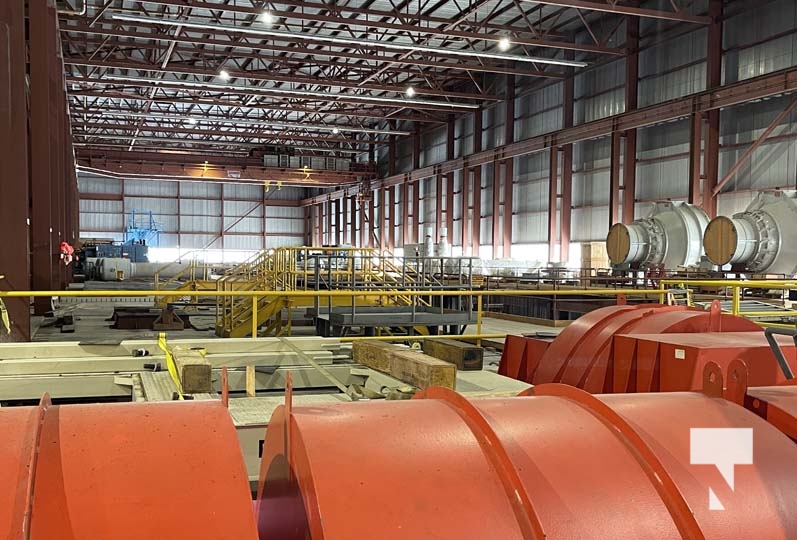

(Today’s Northumberland file photo)
By Cecilia Nasmith/Today’s Northumberland
An exhaustive report on the Wesleyville project by Watson & Associates Economists Ltd. at Wednesday’s meeting of Northumberland County council seemed to raise as many questions as it answered.
One area of confusion was the estimated 1,700 construction jobs the project would create – when, as Councillor Lucas Cleveland pointed out, the Bruce project created 18,000 construction jobs when it was only about one-third the size of Wesleyville.
Councillor Scott Jibb said he had recently met with three Wesleyville representatives who said there might be as many as 10,000 jobs. But Jibb was also concerned about what he termed a downfall – the interim between the boom times of peak construction, followed by a lag time when the facility is completed but not yet operating at full capacity. It’s an area the report does not address, Jibb said.
“Our economy is going to build from a housing perspective, from a school perspective, from a hospital perspective, from a transportation perspective, and many more I could add to the list, to ramp up for potentially 10,000 employees during construction at the Wesleyville plant and then, when construction is complete, it’s going to be ramped down to 1,600 jobs,” he stated.
Port Hope Councillor Todd Attridge (representing the municipality in the absence of Mayor Olena Hankivsky) said their research indicated 12,000 jobs in the construction phase. But Attridge’s primary concern was the jobs forecast – and whether AI had been taken into account, given that AI is reducing jobs that involve computational and other technological skills.
“We can only use the information we have today to guide our analysis,” Watson Manager Erik Karvinen noted.
Attridge also wondered what effect the Wesleyville project might have on Cameco, the municipality’s largest employer.
Cleveland also cited property-tax issues that have arisen in the communities surrounding the Bruce and Kincardine projects.
“Originally the nuclear facility had a fair share with property taxes. However, the issue is, over the last 20 years, that tax burden has systemically and systematically shifted from the nuclear property to residential and commercial rate payers,” Cleveland noted.
Councillor Brian Ostrander wondered about the “more or less 7,000 to 12,000 transient jobs, non-permanent jobs, coming to the county – in particular to Port Hope – with zero or near-zero capacity for transit and transportation.”
The GO commuter system is not expected to reach this area for many years to come, Ostrander pointed out.
“It behooves us to wrap our minds around what that is going to mean, from an advocacy perspective, to our friends at the province – 12,000 jobs, mostly coming out of Durham and Toronto, and another 2,000 more permanent jobs with people living wherever they want to live. We don’t get to dictate where that should be. It could be Clarington, it could be Cobourg, it could be Brighton.
“We need to make sure people have that access to get to and from work.”