

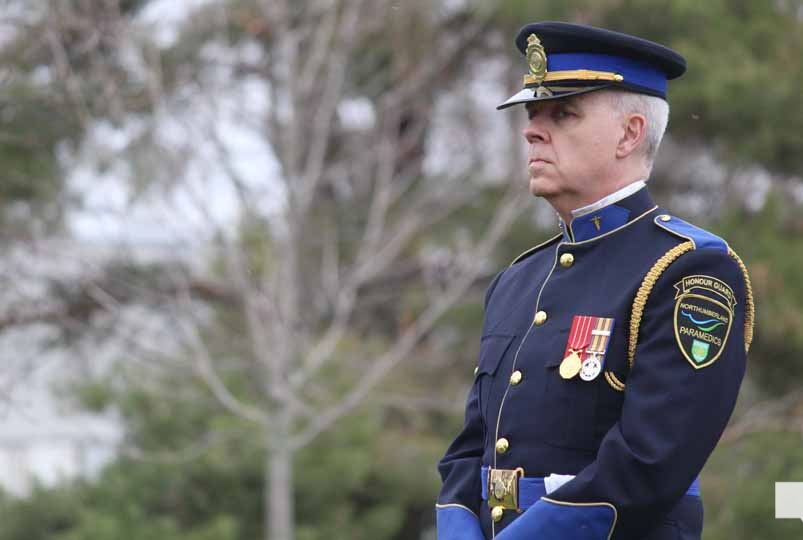
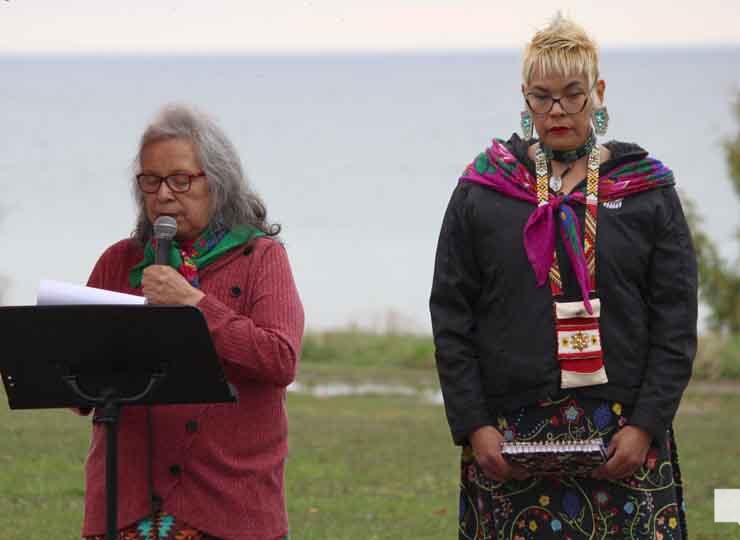
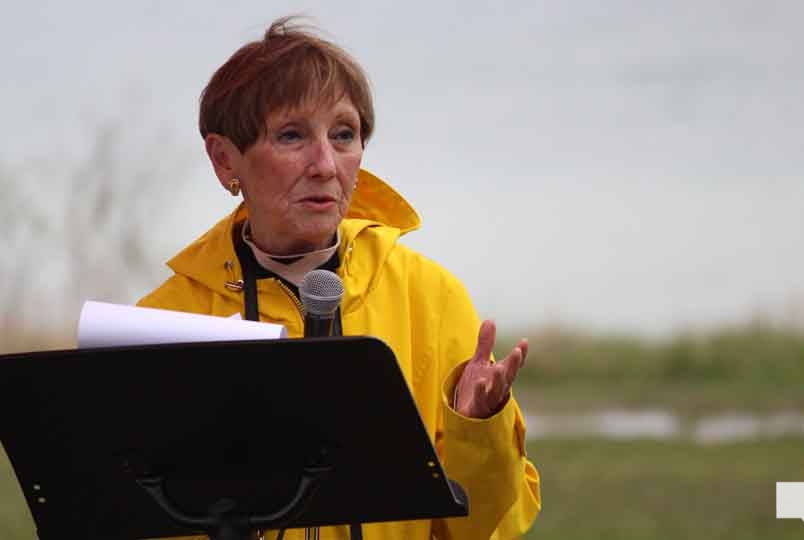
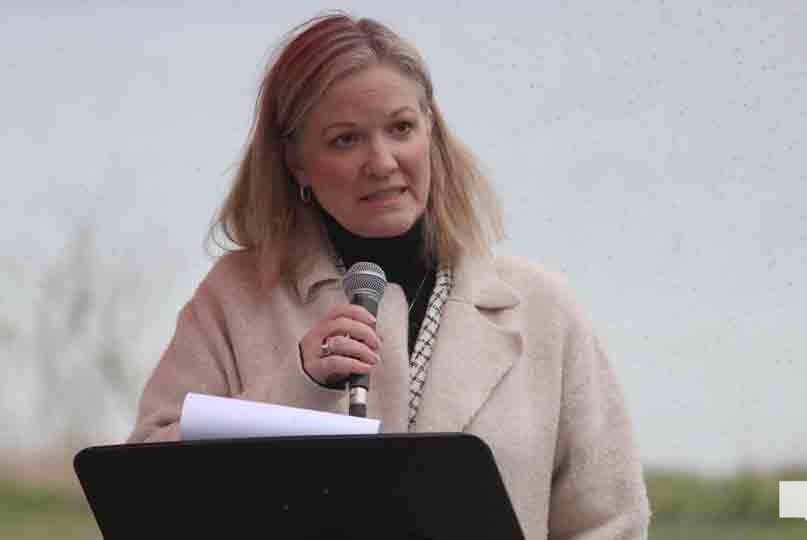
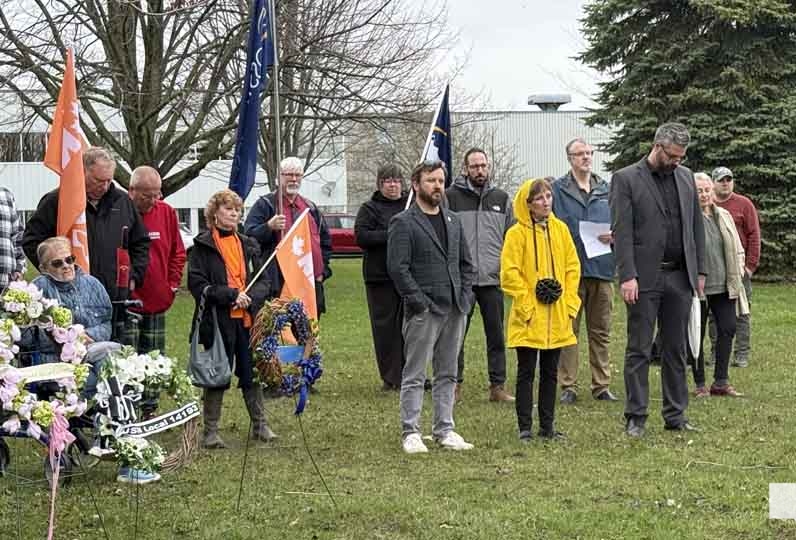
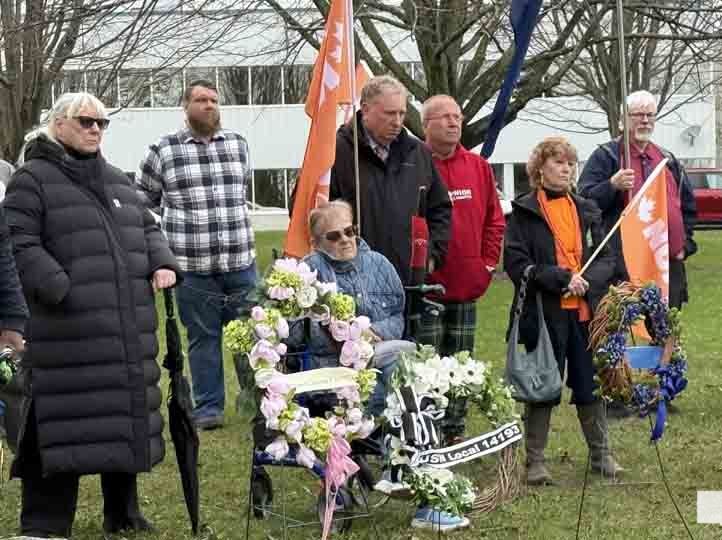
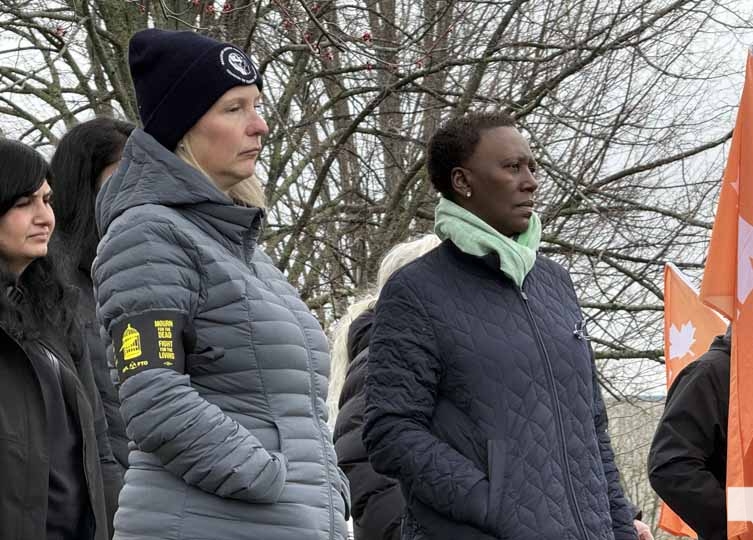
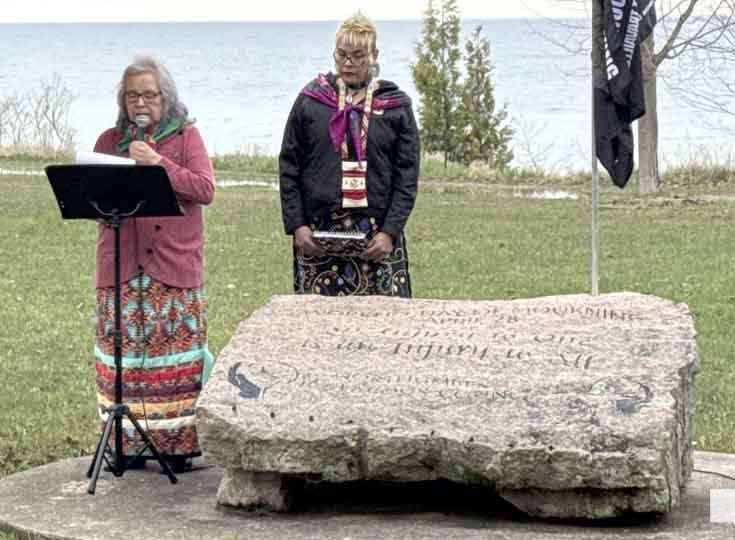
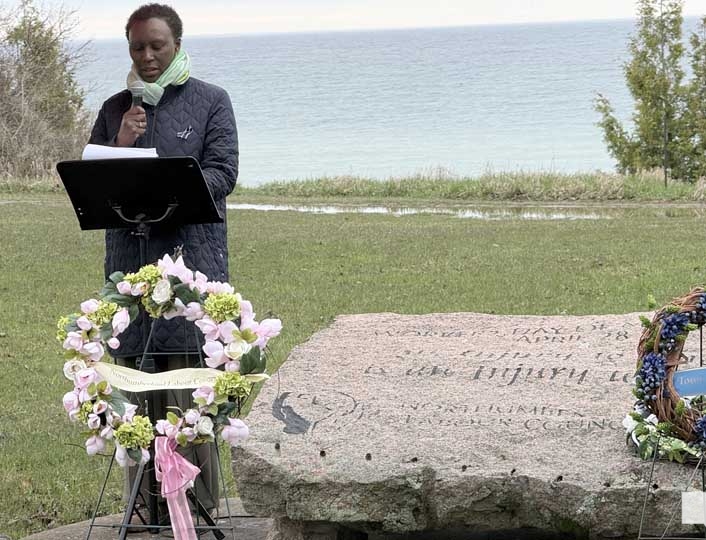

Northumberland Labour Council’s annual National Day of Mourning Ceremony was held on Tuesday, April 28, 2026 at Lucas Point Park in Cobourg
To commemorate the Day of Mourning, the Northumberland Labour Council emphasizes the importance of psychological health and safety as a fundamental workplace safety issue.
NLC President Dan Tobin said that ,”both physical and psychological workplace injuries are serious and should be treated with equal importance.
Many workers are suffering from burnout, chronic stress, harassment, and mental health crises due to unsafe working conditions.
It’s essential to recognize these injuries and illnesses just as we do for physical ones. We must work to eliminate psychological hazards. These harms are preventable and should not be considered “just part of the job.”
Every worker deserves a workplace that is safe for both their body and mind.
Marsha Smoke Southeast Regional Chief for the Anishinabek Nation
I want to begin by acknowledging the Anishinaabe territory that we are on today, the ancestors who watch over us all, workers, union representatives, leadership, and families who are here today.
I also want to acknowledge and thank the Northumberland Labour Council for inviting me to be here.
It matters that you have created space to recognize First Nations workers and the realities our people face. That recognition is important. It shows a commitment to inclusion, to respect, and to standing together.
And more than that—it is a commitment to reconciliation in action.
The National Day of Mourning is a time to remember workers who have lost their lives, been injured, or become ill because of their work. It is a day to honour them, to stand with their families, and to recognize the impact that loss carries—not just in workplaces, but in homes and communities.
Sadly, we recognize one of our own first responders from here, whose journey to the Spirit World began yesterday. Such a tragedy.
And this is why today is also a day of accountability.
A day that reminds us that workplace injuries and deaths are not inevitable. They are preventable. That every worker has the right to return home safely at the end of the day.
And in a union setting, that message is clear, safety is not a privilege. It is a right.
For First Nations, this day carries an added weight.
Because when we lose a worker, we are not just losing someone from a job site, we are losing a part of our community. A provider. A knowledge holder. Someone who is deeply connected to family, to Nation, and to the land.
That is why this day matters.
As we gather here today, we also have to remember that the work our people do is not separate from the land—it is connected to it.
I wasn’t sure if we were going to see rain or sunshine, but both are important today.
Right now, wildfire season has already begun in places like the Madawaska Valley north of here. Our lands are changing. The risks are growing. And many of our workers and family members are on the front lines of those changes.
We saw it here last year with the ice storm. Communities were cut off. Power was lost. Roads became dangerous. People were put at risk simply trying to get through their day or respond to emergencies. Our workers, hydro crews, emergency responders, and community members stepped up in difficult and dangerous conditions to keep people safe.
This is not isolated. This is part of the larger reality of taking care of the land and the environment.
And alongside the physical risks, there is something we have not treated with the same urgency, the mental health of our workers.
In union spaces, we talk about safety as a right. That must include mental health.
Workers who are exposed to trauma, long rotations away from home, high-risk environments, and crisis situations carry that with them. It does not end when the shift ends. It follows them home, into their families, into their communities.
We cannot continue to treat mental health as secondary. It is not optional. It is part of workplace safety.
That means real supports, access to culturally appropriate mental health services, peer supports, debriefing after critical incidents, and the ability to speak up without stigma or fear of losing work.
Last year, we also lost one of our First Nations firefighters in the north. That loss stays with us. It reminds us that the dangers are real, and that the people who step forward to protect others are often putting everything on the line. physically, mentally, and emotionally.
For us, taking care of the land has always been a responsibility. It is not just about the environment, it is about our way of life, our families, and the future of our Nations.
At the same time, we know that many of our people work in industries that support our livelihoods, forestry, energy, construction, and resource development. These are not just jobs. They are how our families are supported, how our communities move forward.
But there has to be a balance.
We cannot accept a choice between economic survival, or the safety of our workers, or the health of our lands, and that includes their mental well-being.
We have to find ways to work alongside one another, individuals, workers, unions, industry, and governments, to ensure that safety is a priority, that the environment is protected, and that supports are in place.
Because when the land is not cared for, the risks increase.
And when the risks increase, it is our workers who feel it first, physically, mentally, and emotionally.
So today, as we remember those we have lost, we also carry a responsibility, to do better.
To protect our workers.
To protect our lands.
And to support one another, not just in moments of crisis, but in the healing that must follow.
Healing is not something people should have to carry alone. It happens in community. It happens when we look out for one another, when we check in, when we create space for people to speak and to be supported.
That is how we honour those we have lost.
And that is how we protect those who are still here.
Be well, Be safe, and We’ll see you again.
Miigwech, Thank you
Chris Clarke President OSSTF District 14
I am honoured to be asked to speak at this year’s Day of Mourning, even though I do so from a place of significant privilege.
In my day-to-day work, I am physically safe. I spend my time doing union work—work that allows me to stand up for others, advocate for improvements, and help people navigate some of the most difficult moments of their working lives.
I often get a degree of distance from the most acute challenges facing our schools, while still having the privilege of seeing positive change and hard-won resolutions when they happen. That is not the reality for many workers across this province, including those in our sector.
We are experiencing a retention crisis in education—not because people don’t care about the work, but because for many it is physically and psychologically unsafe daily.
The rules of engagement established by the Ministry of Labour under the Occupational Health and Safety Act too often fail to reflect the real conditions educators and education workers face.
The work can feel never-ending, yet it is essential: essential to protect those who are working today, and essential to honour those who have already been injured or killed on the job.
And yet, working in education is not only about hardship.
Working with young people—even those whose behaviours may at times present risks—is a profound privilege.
Many educators will tell you that one of the best parts of this job is how much we learn from our students.
Everyone enters a learning space carrying experiences that are valid, deserving of support, and worthy of care.
They matter.
I learned that lesson clearly when I began teaching in Campbellford in 2016. I grew up a city kid, and I knew very little about rural life—about farming, hunting, and many of the realities my students lived every day.
My inexperience showed often. But I approached my students honestly and authentically, and they met me with generosity.
They taught me as much as I taught them, and we built real relationships grounded in mutual respect.
One of the young people I came to know during that time was Bailey McDonald.
Bailey wasn’t even my student, but because of who he was, he became part of my school life.
He would check in with other senior students I was teaching, stop to talk, joke, and share plans about the future and work.
Those human moments—the connections built in hallways and classrooms—are what make the hardest parts of this job bearable. Bailey was socially connected, widely liked, always smiling, often laughing.
He mattered.
There is a reason why I speak his name today, which is an unfortunate and sad truth.
The company 18 year old Bailey worked for was fined $100,000 after admitting responsibility for the conditions that led to his death on the job.
In January 2017, Bailey was instructed to use a propane torch to melt and clear frozen ground around the landing-gear legs of a transport trailer so it could be moved.
When the ice lost its stability, the trailer fell—and we lost Bailey.
There is not a Day of Mourning that passes without me thinking of him: the impact he had on my life, his family and his friends. I also often reflect on the deeper lesson his loss leaves behind.
Every person who is killed or injured on the job has a network— family, friends, coworkers, a community.
These are not isolated incidents.
They ripple outward, affecting an entire village.
There is no acceptable loss of human life in the pursuit of profit or in the name of efficiency.
A six-figure fine is not equivalent to a young person’s life.
We want mitigation and risk assessment prioritized, not punishment after the fact.
We must continue to demand that employers and industries treat workers as whole human beings—not as assets to be gambled.
They are people deserving of protection. Comprehensive safety planning, meaningful regulations, and appropriate enforcement are not optional inconveniences.
In education and beyond, the effort required to do better is always worth it if it keeps workers whole and our parents, siblings, friends, and students with us.
So today, I ask all of us to recommit—to health and safety advocacy, to the labour movement, and to one another.
We must continue to apply pressure to where power resides, to demand better conditions for workers, and to refuse to accept preventable injury or death as inevitable or the cost of doing business.
We owe it to Bailey.
We owe it to every worker we have lost, or could lose.
And we owe it to those who have yet to come home safe and whole at the end of their workday.

Author: Pete Fisher
Has been a photojournalist for over 30-years and have been honoured to win numerous awards for photography and writing over the years. Best selling author for the book Highway of Heroes - True Patriot Love