

By Jeff Gard/Today’s Northumberland
Stephen Holmes, who grew up in Port Hope and attended high school in Cobourg, is now a teacher and also an author helping young readers discover the worlds of science, technology, engineering and problem-solving.
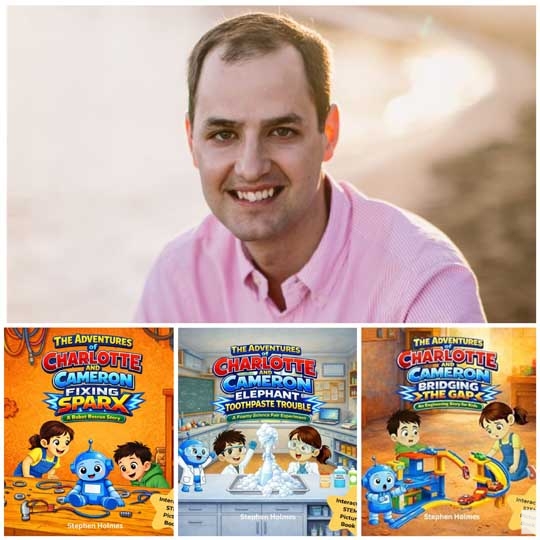
Holmes, a teacher at St. Andrew’s College in Aurora, has self-published three children’s books designed to introduce STEM (Science, Technology, Engineering, Mathematics) concepts to kids with a suggested audience between the ages of four and nine for the series The Adventures of Charlotte and Cameron. The books were inspired by his own children – five-year-old Charlotte and three-year-old Cameron.
Holmes has a passion for education.
“I like having side projects where I can learn new skills,” he said. “I thought it would be interesting to learn how to publish a book.”
Holmes graduated from the former Cobourg District Collegiate Institute East (now Cobourg Collegiate Institute) in 2008 as part of the school’s first International Baccalaureate graduating class.
The IB program, which is scheduled to be discontinued locally in June 2027 by the Kawartha Pine Ridge District School Board, was designed to prepare students for university-level academics beyond the standard Ontario curriculum.
Outside the classroom, Holmes was also heavily involved in high school athletics, particularly track and field and cross-country running. Those interests initially shaped his career ambitions after high school.
After graduating from CDCI East, Holmes enrolled at the University of Guelph to study human kinetics, envisioning a future in chiropractic care, medicine or another type of athletics-related field.
At the time, teaching was not part of the plan. That changed during his tenure in Guelph while working a summer job teaching science camps for children at the university.
“I just kind of fell in love with teaching and working with kids,” Holmes said.
The experience quickly changed the direction of his career. By the time graduation arrived, Holmes had applied to both chiropractic and teachers colleges. He was accepted to teachers college and although he was invited for an interview for chiropractic school, he decided not to pursue it.
“I didn’t go because I was like I know that teaching’s for me, I want to do that and the rest is history,” he said.
Holmes later graduated from the University of Toronto and began teaching at St. Andrew’s College, initially hired to cover a maternity leave position.
More than a decade later, he is now entering his 11th year at the school, where he teaches Grade 8 math and science as well as Grade 5 science and physical education. He has also coached middle school cross-country, track and field and basketball teams.
While teaching remained his primary focus, Holmes eventually found himself searching for another creative challenge outside the classroom.
The idea for writing children’s books emerged only a couple of years ago.
“It was last year where I was like, ‘This is the year. I’m going to figure out how to do it,’” Holmes said.
What initially seemed like a straightforward project quickly became more complex than expected.
Holmes originally envisioned a short bedtime story of roughly 10 to 12 pages for younger children.
However, after researching self-publishing requirements, he learned books generally needed to be at least 24 pages long.
That required him to stretch out the story he planned.
The next challenge involved illustrations. Holmes knew he did not have the artistic skills needed to create the visuals himself and initially hired an illustrator to help bring the stories to life.
While the collaboration provided useful ideas and direction, Holmes said his exact vision wasn’t landing on the pages.
Rather than abandon the project, Holmes began experimenting with AI-assisted illustration tools and gradually taught himself how to create the artwork independently. By the second and third books in the series, he was handling the illustration development himself.
The first story in the series, Fixing Sparx, introduces readers to the robot character Sparx after he suddenly shuts down and requires repairs. Charlotte and Cameron work together to diagnose the issue, untangle wires and solve the problem.
“I always thought it would be cool to include a robot of some sort,” Holmes said, noting he envisioned Sparx as a recurring character in the series.
That idea expanded into Elephant Toothpaste Trouble, which centres around a chemistry experiment gone wrong, and Bridging the Gap, where the characters attempt to build a functional bridge for toy cars after their original design fails.
Each story emphasizes teamwork, perseverance and learning through mistakes.
One of the defining features of the books is their interactive format. Throughout each story, readers are prompted to stop and answer questions, predict outcomes or help solve challenges alongside the characters.
Holmes explained the intent is to create dialogue between kids and adults while they’re reading.
“I wanted it to be something kids could relate to and so for my engineering challenge it’s like a little car garage toy that breaks down and they have to fix. The robot, it’s like their toy robot and the science experiment that I chose for that book is elephant toothpaste which is like this bubbly explosion so just making them relatable for kids, things that they would enjoy.”
While Cameron is still too young to fully understand the connection, Holmes said Charlotte finds it cool seeing herself and her brother represented in the books as the title characters.
“She enjoys reading them and pointing out all the solutions,” he said.
Holmes believes STEM education has become much more prominent in classrooms over the last decade and wanted to introduce those concepts to children at an earlier age. He doesn’t remember these types of books being available when he was a young reader.
The books are primarily sold through Amazon (https://www.amazon.ca/Adventures-Charlotte-Cameron-Fixing-Sparx/dp/B0GHZGCWH4), though Holmes has also learned how to distribute them through educational catalogues, allowing schools and libraries to order copies as well.
The global reach of self-publishing has surprised Holmes, though he recognizes Amazon is a worldwide marketplace. Aside from Canada, of course, copies of his books have also been purchased in the United States, the United Kingdom and Germany.
Throughout the publishing process, Holmes credits his wife, Taylor, whom he met while attending university in Guelph, for supporting him through late nights spent reviewing drafts and illustrations.
For now, Holmes believes the trilogy is complete, even if one component of STEM with a focus on math is missing.
“That one’s a little more challenging to make fun and engaging for kids,” he said, while allowing he still has some ideas in the back of his mind.
“I have many, many ideas of how to write more books on this, but for now I think it’s complete.”
The Adventures of Charlotte and Cameron: Fixing Sparx
When Sparx the robot suddenly shuts down, Charlotte and Cameron jump into action. With wires tangled, parts missing, and confusion everywhere, the two young problem-solvers must work together to figure out what went wrong and how to fix it.
The Adventures of Charlotte and Cameron: Elephant Toothpaste Trouble
When Charlotte and Cameron decide to try a fun science experiment called elephant toothpaste, things don’t go exactly as planned. The bubbles don’t grow, the reaction fizzles, and it looks like the experiment might be a flop. But instead of giving up, the siblings slow down, think carefully, and work together to figure out what went wrong.
The Adventures of Charlotte and Cameron: Bridging the Gap
What happens when toy cars can’t make it across a big gap?
For Charlotte and Cameron, it’s not just a problem, it’s an engineering challenge. In The Adventures of Charlotte and Cameron: Bridging the Gap, young readers join Charlotte, Cameron, and their friendly robot Sparx as they head to the workshop to design, build, test, and improve a bridge. Through trial and error, the siblings experiment with materials, discover why some designs fail, and learn how engineers think when solving real-world problems.