

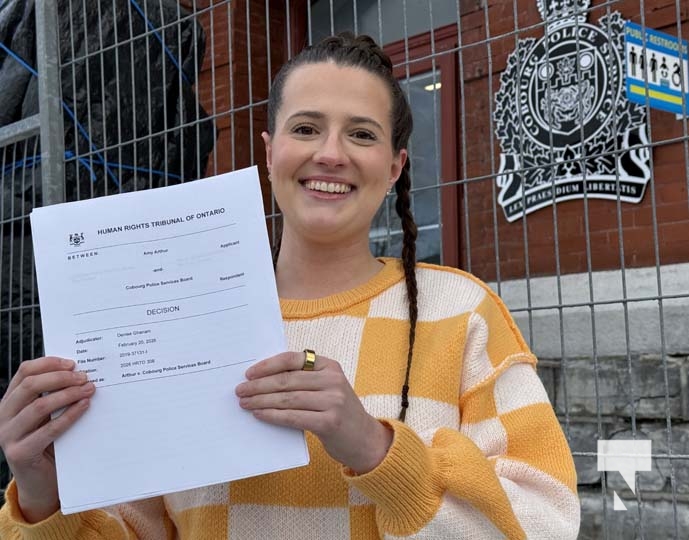
For years, Amy Arthur described her chronic back pain the same way: not as a defining injury, but as a constant presence — “a broken record humming in the background.”
It was a condition she managed through medication, therapy and determination. It was also invisible.
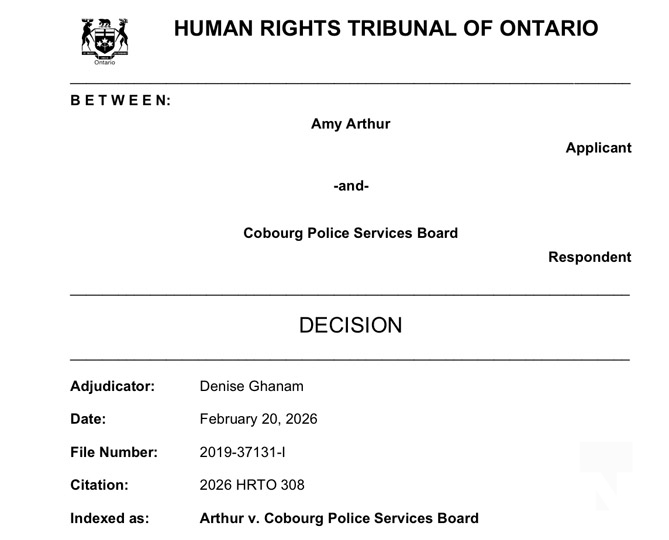
But on February 20, 2026, that invisible disability took centre stage in a landmark ruling from the Human Rights Tribunal of Ontario, which found the Cobourg Police Services Board discriminated against Arthur when it removed her from its Auxiliary Officer program in 2019.
The decision awarded Arthur $20,000 in damages and, more significantly, affirmed that her experience reflected a broader issue — how invisible disabilities are understood, disclosed and accommodated in workplaces tied to physically demanding careers.
A pathway into policing
Arthur’s interest in policing began in her hometown of Cobourg, where joining the volunteer Auxiliary Officer program offered a path toward a career in law enforcement.
The role, while unpaid, is often viewed as a stepping stone for aspiring officers. Applicants undergo recruitment screening, training and supervision — a structured environment the tribunal later said qualifies as employment for human rights purposes.
Arthur entered the program in early 2019 while attending university full-time. At the time, she had spent nearly a decade managing chronic low back pain that began during her years as a competitive gymnast.
Medical imaging showed no structural abnormalities, yet the pain persisted. Over time, she turned to physiotherapy, injections, counselling and cognitive behavioural therapy to maintain function. By her account, the condition did not prevent her from lifting weights, running or training.
She believed she was capable of serving.
The moment of disclosure
The turning point came weeks into training.
During self-introductions in March 2019, Arthur told fellow recruits and supervisors about her chronic pain. Days later, she referenced it again in emails explaining she might be late to a session due to a medical appointment exploring ketamine treatment for pain management.
What followed, the tribunal found, was not a dialogue about accommodation but a shift in perception.
Internal emails among supervisors questioned her suitability and physical capability. A superintendent later testified he had concerns about her effectiveness in potentially physical situations.
Arthur, meanwhile, said she believed her condition did not limit her performance and that the interview questions she answered months earlier were subjective — asking whether anything would prevent her from performing duties. From her perspective, the honest answer had been no.
The tribunal ultimately agreed the situation was more complex than a question of honesty alone.
Integrity or assumption?
The police service maintained Arthur’s removal stemmed from integrity concerns tied to her failure to disclose the condition during recruitment interviews. A social media post in which Arthur wrote she had hidden her pain at job interviews was cited as evidence.
But the tribunal found inconsistencies in that explanation.
Documentary and oral evidence showed supervisors also discussed her disability and potential treatment when considering her removal. Those discussions, Vice-chair Denise Ghanam wrote, demonstrated the disability was at least one factor in the decision.
That finding established a prima facie case of discrimination — shifting the burden to the police board to show it had met its duty to accommodate.
A process that never happened
Central to the ruling was what did not occur after Arthur disclosed her disability.
Between the March disclosure and an April meeting where her participation ended, supervisors did not ask for medical clarification, explore possible restrictions or discuss accommodations. Nor did they invite Arthur into a conversation about how her condition might be managed within the role.
That absence of inquiry amounted to a breach of the procedural duty to accommodate, the tribunal found. The failure to engage in any accommodation process also constituted a substantive breach.
Employers, the decision emphasized, must gather sufficient information and explore reasonable accommodations rather than rely on assumptions about disability.
A resignation under pressure
The final meeting on April 24, 2019, became a defining moment in Arthur’s account.
She testified she was presented with a resignation form and felt unable to leave the police station without signing it. Ultimately, she completed the document, listing chronic back pain as the reason.
Supervisors testified resignation was offered as an alternative to recommending termination.
The tribunal concluded the resignation was not voluntary and amounted to a termination — a finding that shaped the remedies awarded.
Emotional fallout and altered plans
Arthur’s time in the auxiliary program lasted less than two months and did not involve active duty. Still, the tribunal accepted evidence that the experience had a lasting emotional impact.
Arthur described a decline in self-worth and depression, compounded by fears about how the separation might be perceived by other police services. The situation left her facing a dilemma: disclose the experience and risk stigma tied to disability, or omit it and risk appearing dishonest.
Ultimately, she chose not to pursue policing applications.
While the tribunal found insufficient evidence to support claims of lost future earnings, it acknowledged the psychological effects and the significance of losing a hoped-for career pathway.
The tribunal’s remedy — and its message
In awarding $20,000 for injury to dignity, feelings and self-respect, the tribunal placed the case within the mid-range of recent disability discrimination awards. The ruling also ordered pre-judgment interest dating back to 2019.
But beyond the monetary award, the decision carries broader implications.
It underscores that volunteer roles linked to career progression may be protected under human rights law. It also highlights the complexities of disability disclosure, particularly for conditions that are not outwardly visible but can trigger assumptions about capability.
For Arthur, the ruling offers recognition of an experience she said was shaped by stereotypes she had long tried to challenge.
Her case reflects a tension many workers with invisible disabilities navigate: the balance between privacy and disclosure, and the risk that openness may change how capability is perceived.
A broader conversation
The decision arrives amid growing awareness of invisible disabilities in workplaces and public institutions. Advocates argue such conditions often require employers to move beyond traditional markers of impairment and engage in individualized accommodation.
In Arthur’s case, the tribunal concluded that conversation never truly began.
Instead, her disclosure became the moment that shifted her trajectory — from aspiring officer to human rights applicant.
Seven years after the events that led to her departure from the program, the ruling closes a legal chapter while opening a wider conversation about how organizations respond when disability is revealed.
And for Arthur, the decision affirms what she maintained from the beginning: that the quiet, persistent presence of pain did not define her ability — only how it was perceived.

Author: Pete Fisher
Has been a photojournalist for over 30-years and have been honoured to win numerous awards for photography and writing over the years. Best selling author for the book Highway of Heroes - True Patriot Love