
By Cecilia Nasmith/Today’s Northumberland
People associate Habitat for Humanity with building affordable housing – but in the interests of housing more families, their focus is broadening to include affordable home repairs.
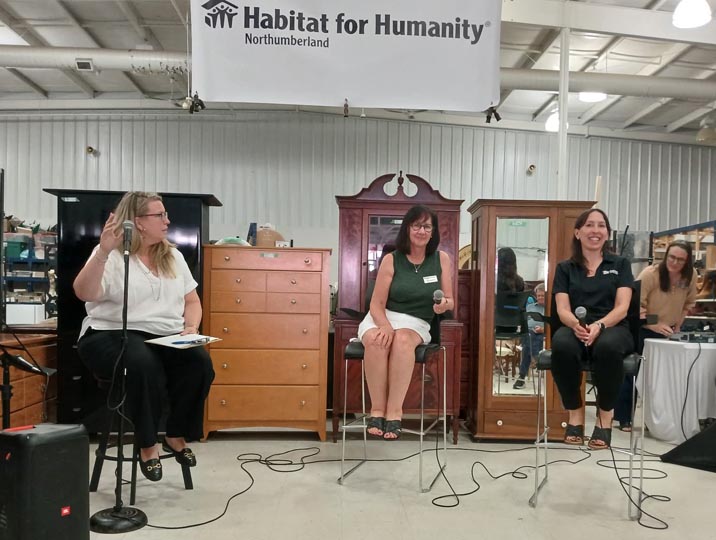
The information was shared in an informal session at Habitat For Humanity Northumberland’s ReStore as part of Habitat In Action Week.
With a semi-circle of loungers, upholstered chairs and dinette seating in the Cobourg outlet, members of the community gathered to hear local Chief Executive Officer Cathy Borowec and Habitat for Humanity Canada Senior Director of Programs Stacey Sawchuk discuss the state of housing today, and how Habitat is striving to meet demands as they evolve.
“The last few years have been particularly eye-opening in Habitat, in that building homes is not enough to make a dent in the housing crisis,” Sawchuk stated.
Offering repairs has gained ground as a way to maintain existing housing before it gets to a point where it is not liveable.
The original model of building remains, she said, but “that repair piece” is becoming more and more important.
Repairs strengthen the housing stock, Borowec added. A house that gets a timely roof repair, mould remediation or accessibility upgrade may continue to keep a family housed.
“Every community in Northumberland County, in the province, in the country has a much more visible homeless population than they have ever had before,” she stated.
People who turn to Habitat tend to be lower-income households, people with disabilities, people of colour, single-parent families. And while those big five-bedroom homes are still needed for large families, Borowec added, some attention must be paid to smaller homes for smaller families or those living on their own.
“What we know is that you can go from safely housed to unhoused in the blink of an eye, but the pathway back up is much harder,” Borowec said.
“In Northumberland, we don’t have a lot of supportive housing and market rentals around here are really hard to make.
“We need for the whole continuum to be healthy along the way so people can get to us.
There needs to be those stepping stones along the way so someone can reasonably own a home again.”
Strong partnerships work best, Borowec and Sawchuk agreed, both private-sector and public.
“Our best partnerships are with our municipalities,” Borowec stated.
“Those are the bodies that sometimes have surplus land. Those are the bodies that can help us get key affordable financing sometimes, because they have avenues that go beyond walking into a bank.”
They also get generous support from the Federal government, she continued. The provincial government hasn’t stepped up so much, but that is beginning to change with steps like the HST and development-charge waivers they advocated for (along with homebuilders’ associations).
Sawchuk said that Habitat is in more than 60 countries, and operates on different models that work in different countries. They are also focusing more on methods and materials that have a lower impact on the environment.
In Northumberland, Borowec said the Town of Cobourg has been one of their best partners.
This Habitat chapter began with what was then called Alexandria Village, a street full of bungalows and semidetached homes from the 1950s that had served as housing for military families who served at the nearby former army supply depot (later purchased by the town and made into Northam Industrial Park).
When the depot shut down, Alexandria Village became housing for clients of the D’Arcy Place Developmental Centre. When that facility closed in 1996, it was suggested as a Habitat project for families – those 29 lots would become 33 homes.
“The Town of Cobourg took back a loan on that purchase, and we were able to repay it – and they used the friendly Habitat rate of interest of zero. We paid that $200,000 at $5,000 a month. When we couldn’t make the payment, they were very forgiving,” Borowec recounted.
Twenty-eight years later, they have housed 79 families throughout Northumberland County (including Alderville First Nation).
A finished house, when those first houses were finished, was worth $180,000. The first house they built in Port Hope, when it was done, was worth $275,000.
“That was huge for us. You can’t buy anything for that now,” she said.
“Habitat finances that – the big part of our work is that we finance those homes. We raise the money to build it and, when people move in, they pay back the mortgage to Habitat.”
Considering that some of their mortgages are in 2002 dollars, it can take decades for Habitat to get the full value back.
“We do have about 37 mortgages on our books, and collecting money from those mortgages helps,” she said.
“We used to say 10 mortgages builds a house. It doesn’t any more.”
The ReStore is another source of income, and they are very proud of their Home Repairs program that refers fully licensed and ensured workers for virtually any job – something that a homeowner might think is too big for the handyman down the street, or for those who don’t know a handyman but may not know whom to call.
“We do have a reputation of being trustworthy, and our work is good,” Borowec stated.
This could be important to seniors or others who don’t want to open their doors to someone they don’t know, Sawchuk added.
“Habitat is a trusted brand name on its own. There’s a sense of personal safety, or at least accountability.”
Borowec recalled how this service began in Northumberland County, when they were finishing up a build in Warkworth with a great team of volunteers that they didn’t want to lose after the build ended.
They also have a variety of models, such as the forgiveable long-term loan for repairs that a home owner might otherwise not be able to afford.
Asked if they would be willing to get involved in ADUs – accessory dwelling units added on to an existing home or built on the property of an existing home – Borowec said they would be willing to entertain the idea.
One woman shared her experiences working at Halcyon Place, a residential complex for seniors in Cobourg. Too many times, she said, calls come in from someone saying, “I’m 87 years old. I’m going to be homeless next month, and I need housing.”
Unfortunately, the county wait list for affordable housing is 10 years.
The woman also shared memories of a time she worked for Habitat and had the job of notifying families who had been chosen for a Habitat home.
“Perhaps the happiest day of their lives, and mine,” she recalled.
“A community where people are safely housed is a safe community, and we don’t have that right now,” Borowec said.
“We are all working to figure out how we can try to fix that or even mend it a little bit.”
There are many avenues to support this work – advocating for affordable housing at all levels of government as well as supporting your local Habitat through volunteering and donations (including donations of gently used goods to the ReStore). And keep Habitat in mind for your home repairs.
To find out more about that program, call 289-252-0999.

Author: Cecilia Nasmith