
Amy Arthur says she hopes her experience with the Cobourg Police Service can ultimately help improve how police services accommodate applicants and employees with disabilities.
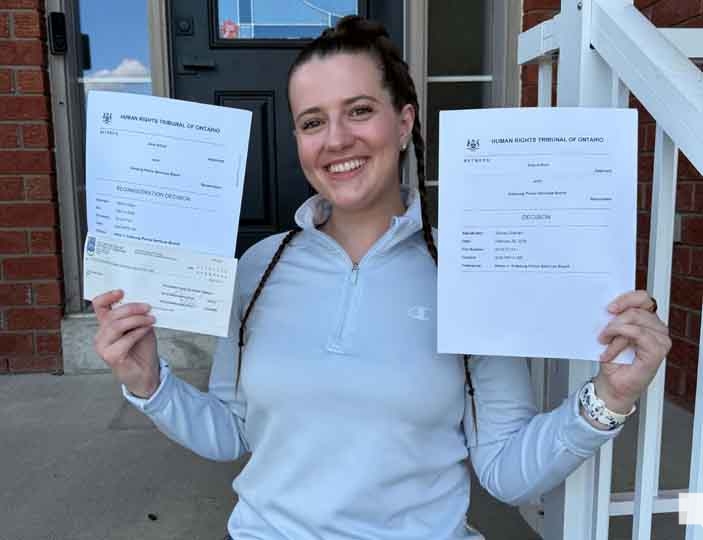
Arthur made the comments following a May 14, 2026, reconsideration decision by the Human Rights Tribunal of Ontario that leaves in place a $20,000 award she was previously granted after the Tribunal found she had been discriminated against because of a disability.
“I hope to have the opportunity to meet with the new Chief of Police to share my experience and discuss how police services can better support applicants and employees with disabilities,” Arthur said.
“My goal is not to dwell on the past, but to help ensure that no one else experiences what I did.”
Arthur said she hopes her experience can contribute to better accommodation practices, greater understanding of invisible disabilities and a fairer and more inclusive recruitment process.
“If my experience can contribute to improving accommodation practices, fostering greater understanding of invisible disabilities, and promoting a fair and inclusive recruitment process, then something positive can come from this journey,” she said.
The latest ruling, Arthur v. Cobourg (Police Services Board), 2026 HRTO 747, was a reconsideration decision issued by Vice-Chair Robert Gabor.
The Cobourg Police Services Board had asked the Tribunal to reconsider its original decision, issued February 20, 2026, which found a violation of the Ontario Human Rights Code and ordered the Board to pay Arthur $20,000 for injury to dignity, feelings and self-respect.
The reconsideration request has now been denied.
The case dates back to January 2019, when Arthur applied to the Cobourg Police Service Auxiliary Officer program.
The program involved a structured recruitment process, including two interviews and a training program that candidates had to successfully complete before beginning their duties.
During her interviews, Arthur answered “no” to questions about whether anything prevented her from meeting the physical requirements of the program.
On March 28, 2019, during the first day of recruitment training, Arthur disclosed that she had chronic lower back pain and had received extensive treatment for the condition.
According to the Tribunal decision, Arthur described her condition as an invisible disability that had caused significant discomfort in her daily life. Medical records showed she had undergone various treatments over several years, including chiropractic care, physiotherapy, massage, steroid injections and numbing injections.
Arthur testified that she had learned to effectively manage the condition and did not believe it would prevent her from performing the duties of an Auxiliary Officer. She said she was still able to lift weights, run and exercise regularly.
Less than a month after disclosing her condition, on April 24, 2019, Arthur was advised she was being removed from the program.
The Police Services Board maintained that Arthur had failed to be honest about her disability during the recruitment process and that her removal was based on a breach of the Service’s core value of honesty and integrity.
However, the Tribunal’s original decision found that evidence and internal correspondence did not support the assertion that dishonesty was the sole reason for Arthur’s removal.
The Tribunal found that concerns had also been raised about Arthur’s ability to perform the role because of her chronic lower back pain and potential treatment involving ketamine.
Those inconsistencies led the Tribunal to conclude that Arthur’s disability was at least one factor in the recommendation to remove her from the Auxiliary Officer program.
The Tribunal also found that the Police Services Board failed in its duty to accommodate Arthur.
Following disclosure of her disability, the Board did not properly inquire into the nature of the condition, how it might affect her duties or what accommodation she might require.
The Tribunal noted that between March 28 and April 24, 2019, the Board did not ask Arthur about her condition or how it might affect her ability to perform the role. It also did not request clarifying medical information concerning her disability, restrictions, treatment or medication, nor did it ask what accommodations she might require.
The Tribunal concluded that the Board’s failure to make those inquiries breached its procedural duty to accommodate.
It also found that there was no meaningful attempt to engage Arthur in an accommodation process, constituting a failure to meet its substantive duty to accommodate.
The Board subsequently sought reconsideration of the February decision, arguing that the Tribunal’s findings conflicted with established jurisprudence and procedure.
In the May 14 decision, however, Vice-Chair Gabor rejected those arguments.
Gabor wrote that the Tribunal had correctly applied the established principle that discrimination does not have to be the only or primary reason for an action. It only needs to be a reason.
The reconsideration decision also found that Arthur’s disclosure of her chronic back pain during the first training session provided enough information to raise concerns about her ability to perform the role and triggered the Board’s duty to accommodate.
Gabor wrote that the Board’s failure to further inquire into Arthur’s condition and potential accommodation needs was consistent with established human rights law.
“The Request for Reconsideration is denied,” the Tribunal ordered.
The original $20,000 award therefore remains in place.
Arthur said she now hopes the experience can be used to help others.
She said she would welcome the opportunity to speak with Cobourg’s new Chief of Police, Chris Leather, about what happened and about how police services can better support people with invisible disabilities throughout the recruitment and employment process.
The case began more than seven years ago and has now resulted in two Tribunal decisions finding against the Cobourg Police Services Board.
The reconsideration decision was dated May 14, 2026, and released under File No. 2019-37131-I.
Source: Human Rights Tribunal of Ontario, Arthur v. Cobourg (Police Services Board), 2026 HRTO 747 (CanLII).
(The cheque awarded was for $23,131.57 which included interest)

Author: Pete Fisher
Has been a photojournalist for over 30-years and have been honoured to win numerous awards for photography and writing over the years. Best selling author for the book Highway of Heroes - True Patriot Love