
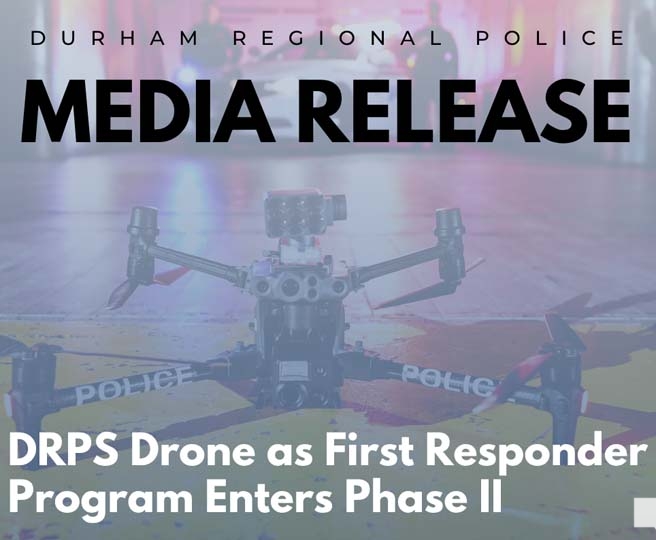
The Durham Regional Police Service (DRPS) has advanced its Drone as First Responder (DFR) pilot program into Phase II, marking the next stage of this innovative pilot project supporting frontline emergency response.
On Friday, June 26, 2026, the DFR pilot program officially goes live following several months of operational testing. The program will be actively responding to support community safety across Durham Region.
DFR Remote Pilots-in-Charge (RPICs) will operate out of the Real Time Operations Centre (RTOC), providing immediate aerial support to frontline officers responding to emergency calls. This capability allows officers to receive real-time overhead information prior to arrival, enhancing situational awareness and supporting safer, more informed decision-making.
Drone First Responder programs have been used successfully by police, fire, and emergency medical services across the United States. DRPS will evaluate the effectiveness of the DFR program throughout its summer deployment to determine its long-term value for the region.
The DFR program has the potential to support:
Rapid response from call receipt to “on scene overhead”
Enhanced situational awareness for responding officers
More effective and efficient deployment of police resources
Search capabilities for suspects, victims, and missing persons
Increased accountability and transparency, complementing body-worn camera footage
The program will only be used to respond to serious calls for service. It is not used for surveillance or random patrol. Deployment criteria include:
Priority 1 emergency calls involving a high threat of physical harm
Priority 2 urgent calls involving a moderate risk to safety or property
Crimes in progress where suspects are on scene or evidence may be lost
Other calls at the discretion of the Regional Duty Inspector
During Phase II, DFR will deploy from dock stations strategically located across the Region. Locations were selected based on calls-for-service and crime data, airspace and safety considerations, and the availability of suitable installation sites.
Throughout the summer deployment period, DRPS will continue to evaluate all aspects of the program, including site placement, operational effectiveness, and impact on community safety.
All DFR operations comply with Transport Canada authorizations, the approved Privacy Impact Assessment, and all provincial and federal privacy legislation. The system:
Is not used for surveillance
Does not use facial recognition or automated identification technology
Only launches for specific emergency or operational incidents
Does not capture audio
The data gathered during this phase will support an evidence-based decision on the future of the DFR program, including any potential expansion.
Public transparency remains a core component of the project. DRPS will continue to share information with the community to ensure residents understand how the system works and how privacy is protected.
If you have questions about the pilot, please visit www.drps.ca/DFR.

Author: Pete Fisher
Has been a photojournalist for over 30-years and have been honoured to win numerous awards for photography and writing over the years. Best selling author for the book Highway of Heroes - True Patriot Love