

Jeff Gard/Today’s Northumberland
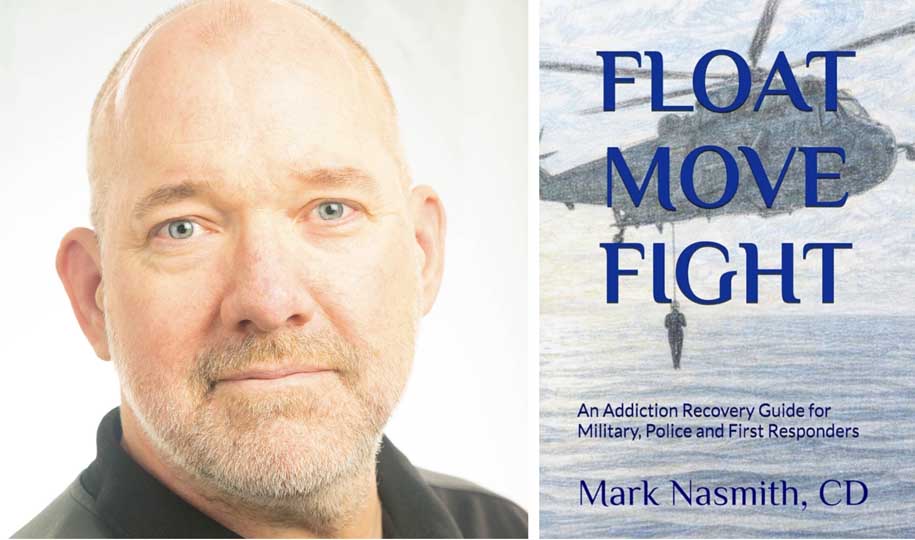
After serving 31 years in the Canadian Armed Forces, Grafton native Mark Nasmith has embarked on a new mission: helping others navigate trauma, addiction and recovery.
Nasmith, who retired in September 2023, has released Float-Move-Fight, a book inspired by his experiences recovering from post-traumatic stress disorder (PTSD) and alcohol addiction as well as his desire to find a new way to continue serving with great purpose. The book, he says, is not an autobiography but rather a practical guide filled with ideas, strategies and hope for people facing their own challenges.
Diagnosed with PTSD in 2019, Nasmith’s efforts to cope eventually led to alcohol addiction. Through trauma therapy and addiction recovery work, he began rebuilding his life and rethinking who he wanted to be moving forward.
“I was getting over the PTSD and the addiction, so I knew I had to change my life,” Nasmith said.
“I started keeping notes basically of who I wanted to be, who I didn’t want to be anymore and, as I did that, I realized that what was helping me on this path was using some of those tools I had learned in the military in terms of planning, checklists, basically trying to apply order to the chaos, and that’s what we did fairly often.”
As he recovered, Nasmith became increasingly involved in helping others through peer trauma support, addiction recovery coaching and volunteer work. He has facilitated hundreds of public Alcoholics Anonymous meetings and found the experience deeply rewarding.
The desire to continue helping others ultimately led him to write Float-Move-Fight. The title reflects a shorthand for the priorities of a warship in combat, he explained.
“It comes down to the fundamentals. To be able to do anything, you have to float so float is the priority. You can’t fight unless you move so moving is the next priority, and then fighting comes after that so it’s very linear. First you must float, then you can move, then you can fight.”
Nasmith compares recovery to those naval priorities. Being healthy and safe represents “float.” Building connections, seeking support and taking positive steps forward represent “move.” The final stage, “fight,” is the difficult work of recovery itself — self-reflection, personal growth, volunteering and helping others.
Nasmith spent much of his career as part of air crews, including 13 years flying aboard Sea King helicopters and four years on the Alpha Jet. He said experiences leading to PTSD vary widely from person to person.
“When these things happened, I was less prepared for it, I was less trained for it, whereas a soldier who walked on the ground in Afghanistan would see people day after day after day. All these come into play – your background, your morals and values, your training, the situation you’re in, and we all have different thresholds and different limits,” he said.
“There is no scientific way to predict who’s going to have a problem and when. It’s just a matter of time and place.”
Nasmith said he only provides a general outline of the circumstances that contributed to his PTSD in the book.
“My intent is not to traumatize anybody else and certainly not to remind anybody else of their own mental health challenges,” he said.
“I was a good soldier, I was on the aircraft, I did everything according to the rule. We as a crew did everything we could to make sure the outcome was positive and successful, and it just went sideways. That’s about as far as I talk about it.”
Nasmith acknowledged that qualities that make someone a successful soldier can become obstacles during recovery.
“I’ll use the example of self-reliance. The military unit is a team, and only a team can accomplish the mission. We take our missions pretty sacred because these are from the Government of Canada – so an individual in the military is extremely self-reliant because we want to be an effective member of the team,” he said.
That same self-reliance can become a problem when dealing with PTSD or addiction.
“Unfortunately, when addiction or PTSD or significant personal issues happen, it’s our instinct to be self-reliant, to not tell anybody, to take care of it, to look at it with confidence. But we’re never trained for PTSD and we’re not trained for becoming addicted to alcohol or anything else so all these great traits that make great soldiers become counterproductive because now I want to take care of it all by myself.”
Instead, recovery requires seeking help from others.
“In addiction recovery, we have to be individuals seeking help, and that is the polar opposite to what a good soldier is as part of a team.”
Nasmith hopes sharing his story will encourage others to get the help they need.
“I think it’s fairly similar to anybody else who speaks up, is just to let (others) know that they’re not alone. I do get fairly explicit about some of the things that happened to me, some of the choices that I made – and the more I talk to other military, police and first responders, there’s a common thread there. We ignore our pain because we put something else before ourselves.”
The decision to speak publicly about his experiences was not difficult, he said.
“I just loved being a leader in the military. I just absolutely loved it. I loved the challenges, I loved the hardships, I loved the successes and I can’t do that anymore, I can’t be that leader anymore and so writing the book is my way…,” pausing as he got emotional speaking, “…it’s a way for me to still stand up in front of people like me who are hurting and say ‘follow me’ or ‘I’m going to open this door for both of us, I’ll go first.’”
Nasmith grew up in Grafton and attended high school in Cobourg. He credits his parents, Cecilia and Ted Nasmith, for instilling values that shaped both his military career and his desire to serve others.
“They raised a child who not only wants to do good things, but was willing to sacrifice and get injured for the right reasons.”
He thanks his mother, Cecilia, who has an extensive background in journalism (including currently for Today’s Northumberland) for being his final proofreader for the book.
His path toward military service began when he joined 598 Sabre Squadron Air Cadets while attending the former Cobourg District Collegiate Institute West. It was his dad who encouraged him to join, showing him a newspaper story about the cadets.
“That was my first definite step towards being in the Air Force as an adult and doing all these great things,” Nasmith said.
He later attended Royal Roads Military College in Victoria, B.C. before completing his studies in Ontario at Royal Military College in Kingston.
Despite his personal struggles, Nasmith remains a strong supporter of military service.
“The benefits are intangible and immeasurable. It’s an experience that I just can’t find outside of the military. In serving the country, you’re putting yourself out there, putting yourself at risk and being with people who are doing the same thing.”
Today, he continues to focus on helping others. In January, Nasmith enrolled in a Master of Counselling Psychology program and hopes to become a psychotherapist and wants to continue serving by supporting others in uniform whether that’s military, police or other emergency services.
Nasmith agreed that you never know who needs help and emphasized that struggles with addiction and mental health are often hidden from view.
“The irony is, when my PTSD manifested I sought help. I was wounded and I knew it and I put my hand up and said I need help. When the addiction hit, I hid it, I lied, I covered it up because somehow it didn’t feel like something I would ever want to share. People who sometimes need the most help are just good at hiding it. There’s signs of course, but it’s individual signs for everybody.”
While the book is rooted in his own experiences, Nasmith said its purpose is simple.
“It’s a very practical, plain language collection of options, of possibilities, of things to think about. Ultimately, it’s a very hopeful book.”
He encourages readers who may not personally need the book to pass it along to someone who might benefit, either someone they know personally or through a Legion branch, clinic, community centre or emergency services organization.
“In that way, if it spreads out and does some good, even if I never hear about it, that’s well worth it.”
Mark Nasmith’s book is available for purchase online at https://www.amazon.ca/Float-Move-Fight-Addiction-Recovery-Military-Responders/dp/1067432809/ref=sr_1_1?crid=3S7H1QYQZKOML&dib=eyJ2IjoiMSJ9.bSbRCODVsFZhJXetELksYw.JfRrloIDtvrgPo5lboMite3PLfwTJvReNNRnE7tAHNQ&dib_tag=se&keywords=float+move+fight+book&qid=1781648870&sprefix=float+move+%2Caps%2C136&sr=8-1