
(Today’s Northumberland file photo)
Below is a press releases issued by Cobourg Mayor Lucas Cleveland on October 15, 2026
Mayor of Cobourg files a complaint with the Ontario Ombudsman against all members of Cobourg Council.
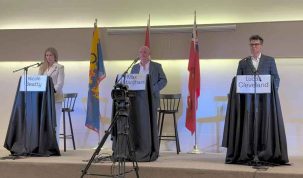
At the Special Council meeting I called on Tuesday, October 13th in my failed attempt to bring to the public serious issues regarding the past term(s) of Council’s decisions, as well to attempt to uncover more information about the Cobourg Police Board’s claims surrounding its own serious fiduciary issues, it has now come to light that members of Council may have broken the sanctity of the Ontario Municipal Act itself.
In a grossly unprofessional attempt to continue a potential cover-up from the public regarding critical information about the Town of Cobourg and the Cobourg Police Board’s finances, led by Deputy Mayor Nicole Beatty and Councillor Adam Bureau (both also sit as the Town of Cobourg’s representatives on the Cobourg Police Board), there were clear and deliberate acts of collusion by Members of Council to privately pre-strategies Motions and Amendments to advance their agenda of silence.
This is a clear breach of the Ontario Municipal Act. These breaches are clearly on both the public record and the video record.
I have filed yesterday, as Mayor of Cobourg, a formal complaint with the Office of the Ontario Ombudsman to review these serious matters. I will fully cooperate once this investigation launches.
I have included below all relevant information pertaining to these matters:
The Ontario Ombudsman rules that municipal councillors are permitted to discuss motions and draft documents outside of formal council settings, provided these interactions do not cross the line into a “meeting” under the Municipal Act, 2001.
Lucas Cleveland
Mayor of Cobourg
Under Ontario law, the critical threshold is whether the communication “materially advances” the business or decision-making of the council. The Ombudsman distinguishes permissible prep-work from illegal, out-of-council decision-making through several key criteria: [1]
1. Serial and Sequential Communications
Councillors frequently share draft motions or seek feedback before an upcoming public meeting. The Rule: The Ombudsman has ruled that sharing a draft motion or exchanging individual opinions sequentially (e.g., via back-to-back phone calls or one-on-one emails) does not technically constitute an illegal closed meeting, even if a quorum is eventually reached over time, as long as they are not deciding on the outcome or coordinating a collective vote outside of a public setting.
The Caveat: The Ombudsman heavily cautions councils against “serial meetings” because they risk splitting up a quorum to structurally evade open-meeting transparency requirements.
2. The “Materially Advances” Standard
If a quorum of councillors (or a committee) meets informally—physically or virtually—and drafts or agrees upon a motion, it changes the dynamic.
If councillors use an informal gathering (or group email threads) to gather information or make minor procedural requests, it is generally permitted.
If they use an informal gathering to debate, come to a consensus, layout a definitive vote, or collectively commit to passing a specific motion before a formal vote takes place, it constitutes an illegal closed meeting.
3. Official Action Requires Council Setting
A municipality cannot legally act on any motion or direction conceived in an informal setting. In landmark reviews—such as investigations regarding the Town of Pelham—the Ombudsman clarified that even if an informal discussion about a matter does not breach the Act, taking action or binding the municipality based on that discussion without passing a public resolution or confirming by-law is acting without legal authority. [1]
emails which excluded one member of council
The Ontario Ombudsman views emails that exclude specific members of council as a significant red flag for “serial meetings” designed to evade open meeting transparency laws.
Excluding a councillor from an email chain where a quorum is reached among the remaining members often triggers an illegal closed meeting investigation. The Ombudsman evaluates these scenarios based on specific rules and notable rulings:
1. The Legality of the “Excluded” Email Chain
Under the Municipal Act, 2001, a meeting does not require 100% attendance; it only requires a quorum (usually a majority of council members). [1, 2]
If a quorum is on the email thread: Even if one or two councillors are deliberately left out, if the remaining members on the email make up a quorum, they are legally considered to be “present” in an electronic space. The Violation: If that quorum uses the email chain to debate municipal business, build a consensus, or coordinate a vote on a motion, it constitutes an illegal closed meeting—regardless of who was excluded.
2. Notable Ombudsman Rulings on Email Chains
The Ombudsman frequently investigates cases where a subgroup of council members attempts to conduct business behind the scenes:
The City of Timmins Ruling (August 2026): The Ombudsman ruled that the Timmins City Council held an illegal meeting when a quorum of councillors and the CAO exchanged emails to discuss a park revitalization plan ahead of a special public meeting. Conducting the debate over email rather than in public violated the Act. [1, 2]
The Township of Frontenac Islands Ruling (July 2025): The Ombudsman found that a quorum of council violated open meeting rules by using an email chain to refine and advance a delegation letter to the Minister of Health, noting that an email chain can legally constitute an “electronic place” where a meeting occurs. [1, 2]
The Township of Ramara Ruling (October 2025): A committee member emailed other members proposing a course of action to remove a program from the budget, which was later adopted. The Ombudsman ruled this email chain was an illegal meeting because it materially advanced council business before the public session. [1]
3. Deliberate Exclusion as Evidence of Intent
When an email chain intentionally excludes specific members of council, the Ombudsman closely analyzes the context. If the excluded member is typically a dissenting voice or an opponent of the motion, the exclusion can be interpreted as an attempt to form a “voting bloc” or a hidden consensus in secret. While councillors are allowed to talk one-on-one, using a group format to structurally circumvent the public—and fellow elected officials—violates the spirit and letter of Ontario’s open meeting laws. [1, 2]

Author: Pete Fisher
Has been a photojournalist for over 30-years and have been honoured to win numerous awards for photography and writing over the years. Best selling author for the book Highway of Heroes - True Patriot Love