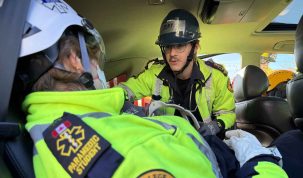

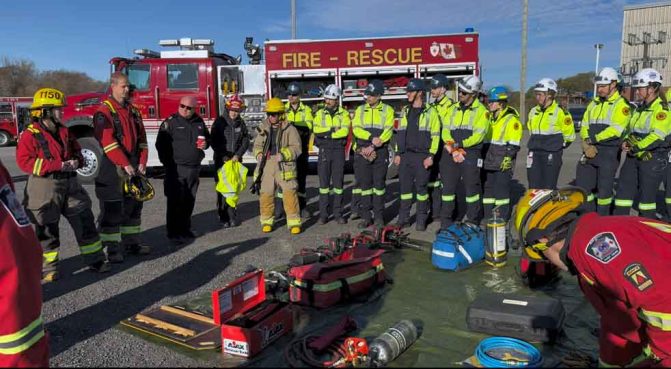
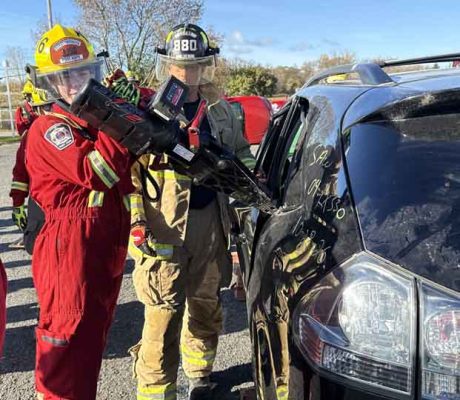
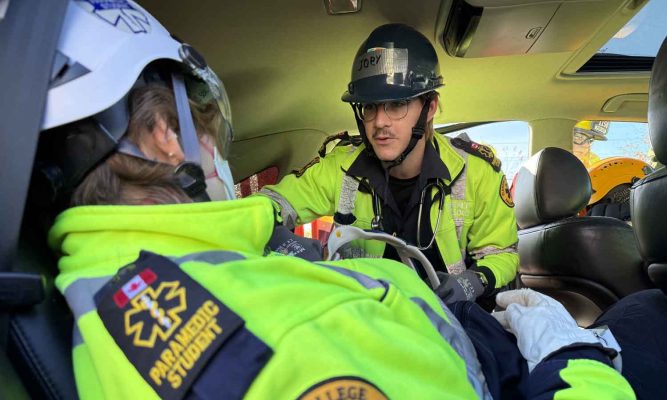
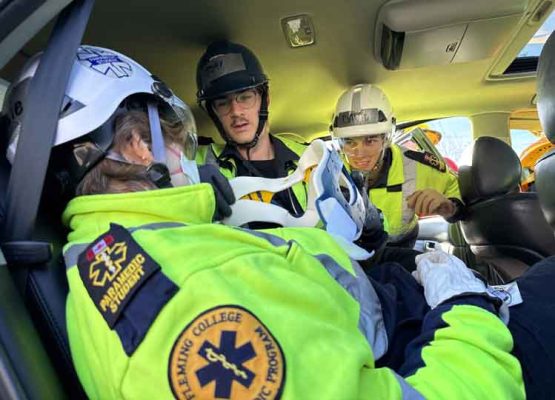
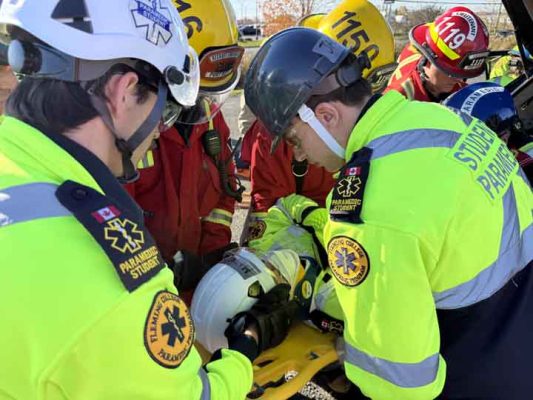
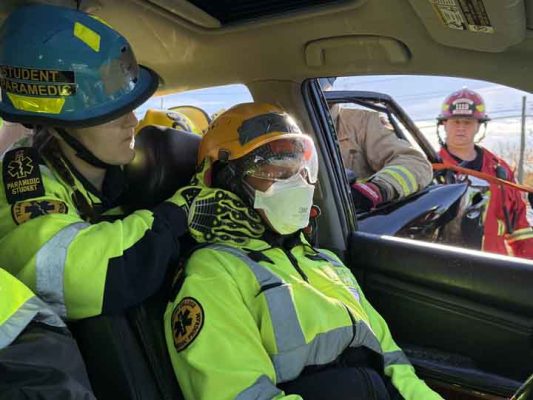
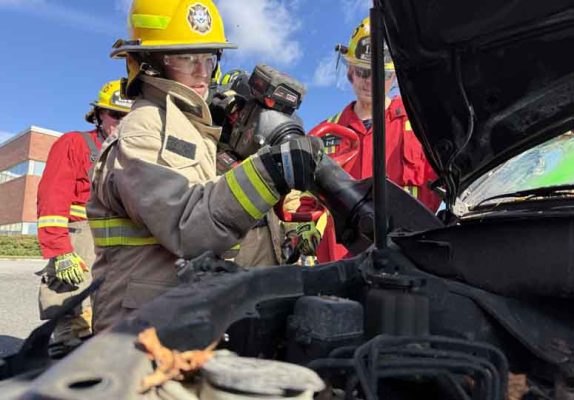
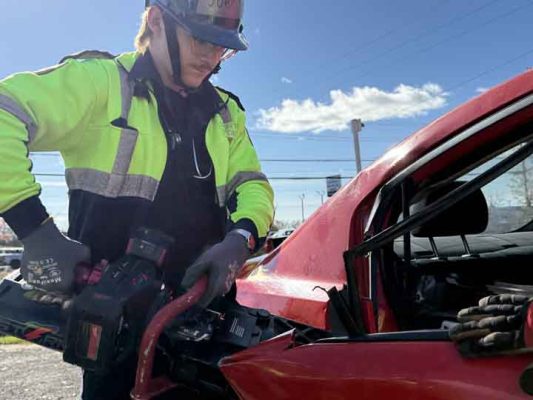
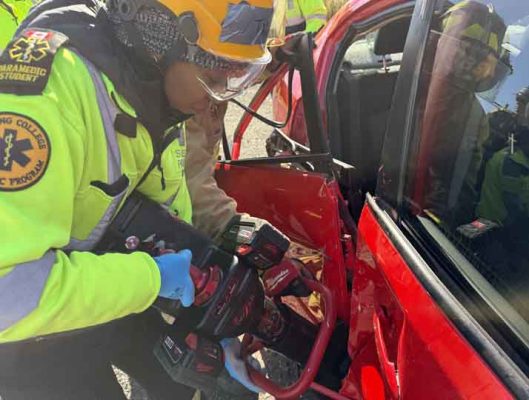
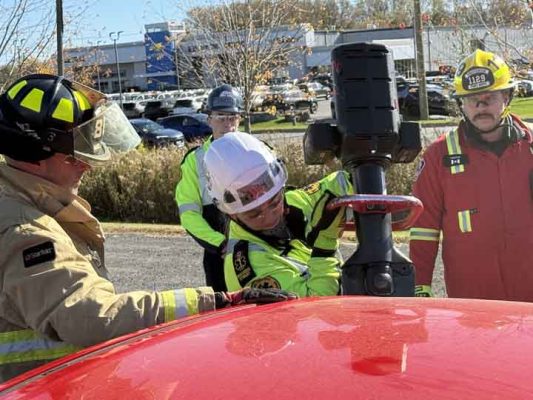
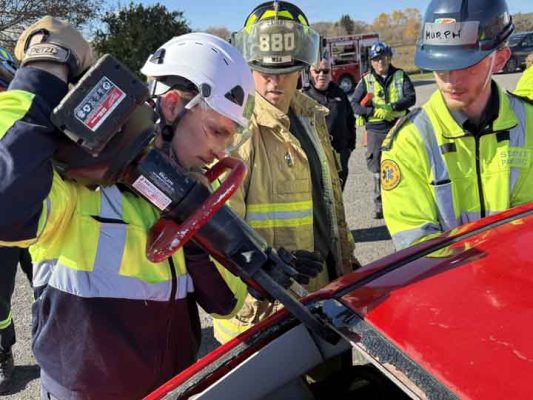
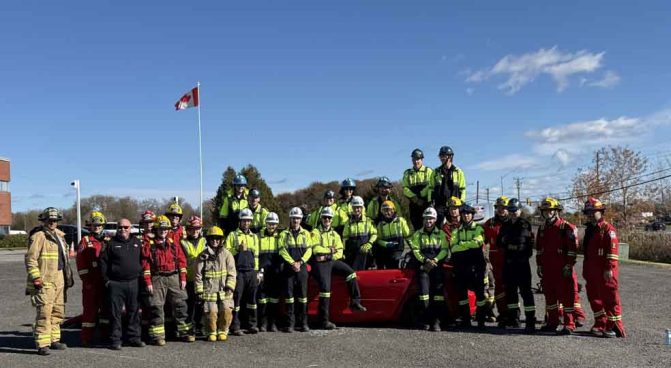
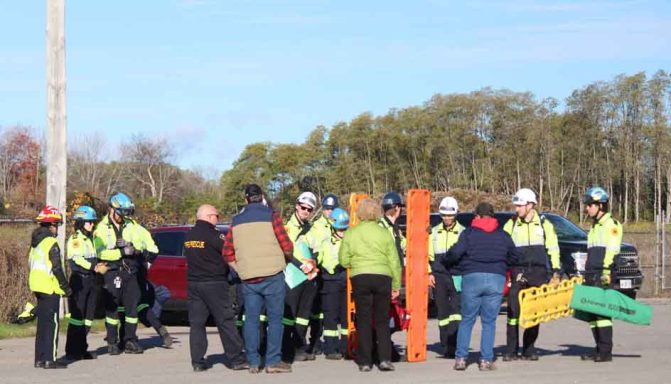
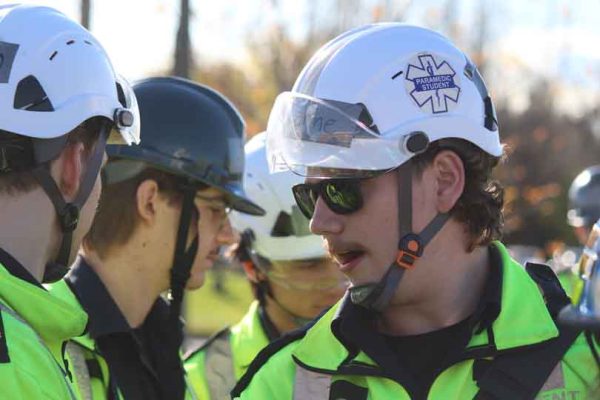
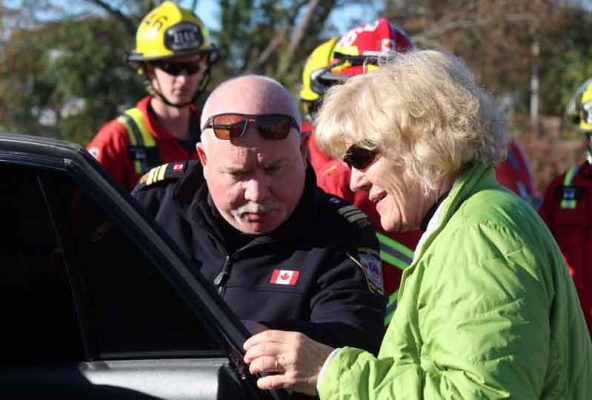
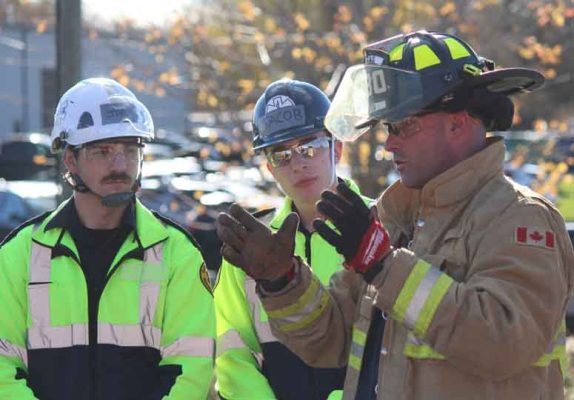
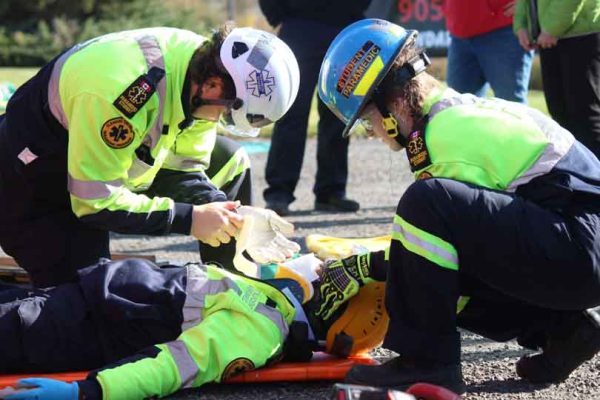
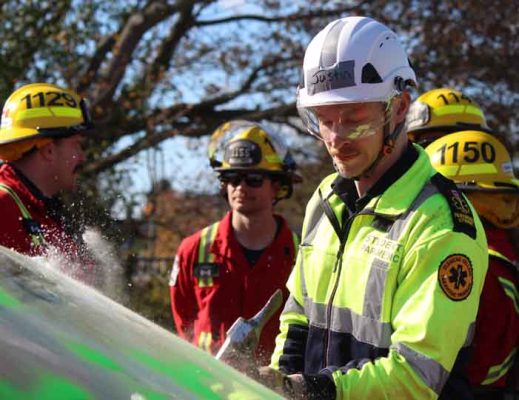
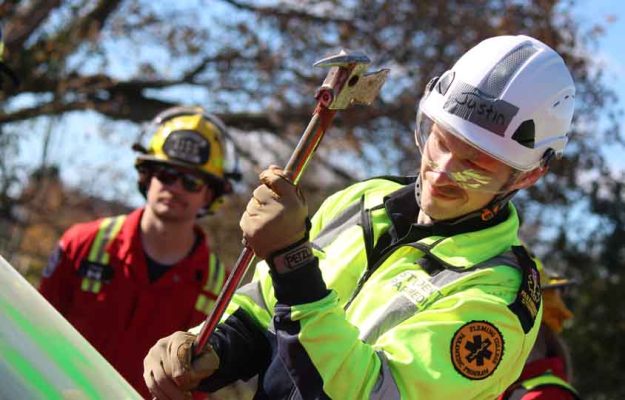
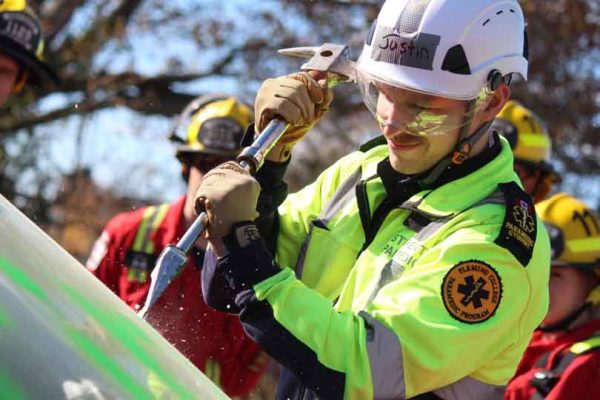
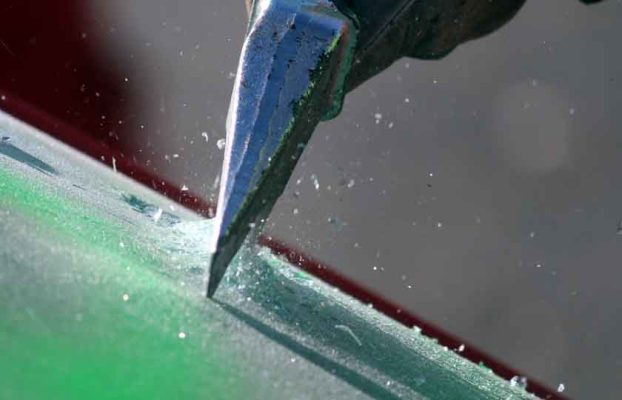
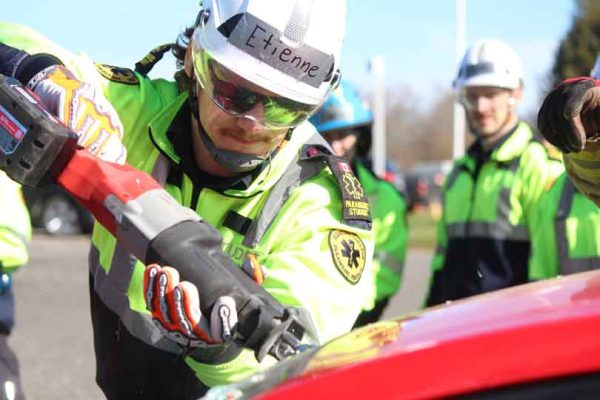
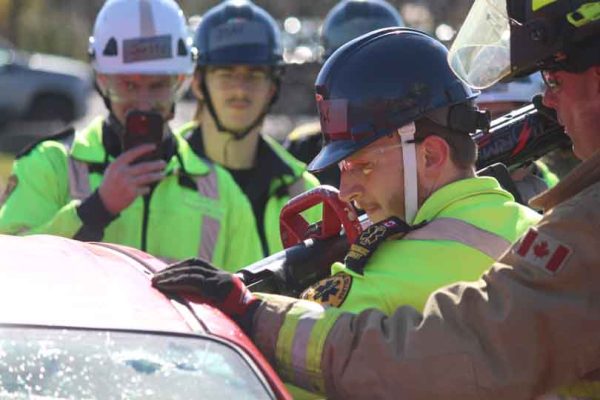
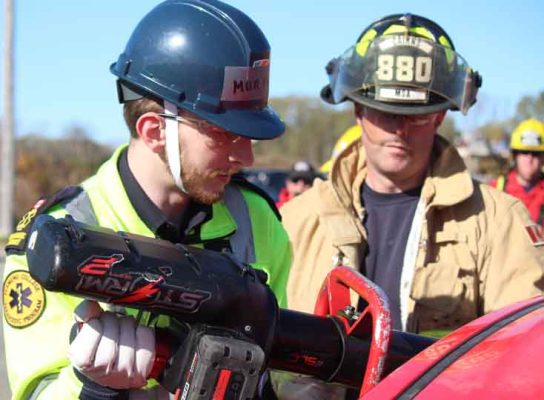
Twenty-five students from Sir Sandford Fleming College’s Paramedic Program got a hands-on lesson in what it takes to work alongside firefighters during a vehicle extrication training exercise in Port Hope on Saturday, October 31, 2026.
The Municipality of Port Hope Fire and Emergency Services once again partnered with the college to give second-year paramedic students an opportunity to experience the challenges of responding to motor vehicle collisions and treating patients who may be trapped inside damaged vehicles.
The training took place at Standard Auto Wreckers, which generously donated two vehicles for the exercise.
Leading the Saturday morning training was Port Hope Fire and Emergency Services Station Captain and Training Officer Bob Cranley, who is also an advanced care paramedic.
Cranley said the annual exercise provides students with an opportunity to take what they have learned in the classroom and apply it in an environment that closely resembles an actual emergency scene.
“Today is our annual Fleming College extrication day where Fleming College paramedic students, second year, come down and work with Port Hope firefighters in a real-time auto extrication scenario day,” Cranley explained.
The benefits extend to both emergency services.
The students are in their third semester and will soon be entering ambulances to complete their field placements. The exercise helps prepare them for the situations they will encounter when responding to emergencies.
“It benefits both services twofold,” Cranley said.
“In a couple months they’ll be in the ambulances completing their placement. So this gets them prepared for that.”
He said the exercise also gives students an opportunity to leave the classroom and experience some of the challenges that come with working at an actual collision scene.
At the same time, Port Hope firefighters benefit from the opportunity to practise and strengthen their own technical skills.
“It’s definitely a partnership,” Cranley said. “We get to develop paramedic students that we’re going to work with in the future on the road at real scenes, and we get our newer firefighters the experience that they need to do the same.”
While paramedics and firefighters have different responsibilities, Cranley said understanding each other’s roles is critical when responding to a serious collision.
Paramedics bring their expertise in patient care, including treating and moving people who are sick, injured or trapped. Firefighters provide the equipment, training and technical skills needed to safely access patients and remove damaged portions of vehicles.
That includes identifying hazards associated with newer vehicle technology, electric vehicles, leaking fluids, potential fires and traffic conditions.
Both services bring different skill sets to the scene, but ultimately share the same objective.
The training also challenges students to work outside the familiar environment of a classroom and communicate with people they may have never worked with before.
Cranley said classroom simulations can only go so far when preparing students for the realities of an emergency.
The exercise recreates situations where paramedics must work with a partner, coordinate with firefighters, manage multiple patients and make decisions under time constraints.
“Today, it’s just the paramedic and their partner paramedic working with an allied resource to manage multiple patients and timed in such a manner to reflect real-world problems and response times,” he said.
“We can simulate it to an extent in a classroom, but here there’s no limits. We can really do it in real time.”
Communication and understanding when each emergency service takes the lead are also important lessons.
At a collision scene, firefighters may need to take control of the technical extrication process, while paramedics must direct patient care and make decisions about medical priorities.
Cranley said working with unfamiliar people in a realistic setting helps students develop confidence and discover how they respond under pressure.
“There’s certainly a comfort level with the students working with their student colleagues. And now they’re working with all these strangers in, again, a real situation, as real as we can make it,” he said.
“There’s a lot of self-discovery here. A lot of communication skills are learned today.”
Following the individual scenarios, students and instructors have an opportunity to review what happened, discuss what went well and identify areas where improvements can be made.
Another important part of the training involved demonstrating the dangers associated with vehicle airbags.
While airbags are designed to protect occupants during a collision, undeployed airbags can pose a serious hazard to emergency responders working to cut apart a vehicle.
Cranley explained that emergency services sometimes receive reports of vehicles being on fire following a collision when the smoke and odour are actually the result of an airbag deploying.
“Being able to demonstrate the airbags going off, the odours and the smoke that it produces in that chemical reaction that causes it to deploy, they can appreciate that the car is not really on fire. It’s a safety system within the vehicle for the occupant.”
However, not every airbag in a vehicle necessarily deploys during a collision.
Responders must know where airbags are located and which ones remain active to avoid accidentally cutting through them or triggering an unintended deployment.
“It’s again for our safety as a responder, but then also the patient safety as well,” Cranley said.
Safety remained a priority throughout Saturday’s exercise.
All students received safety briefings and wore appropriate personal protective equipment, including safety glasses, masks, helmets and gloves.
Standard Auto Wreckers also provided a controlled training environment and vehicles specifically for the exercise, helping eliminate potential hazards wherever possible.
Cranley said the annual partnership between Port Hope Fire and Emergency Services and Fleming College has been taking place for close to 20 years.
He said the value of the training becomes particularly evident when former students return to share their experiences after entering the profession.
“When I see them a year from now or even two years from now, they’re like, ‘Hey, we did this call that day that we spent with the Port Hope Fire Department doing this prepared me for it,’” Cranley said.
For the students taking part Saturday, the exercise offered more than an opportunity to watch firefighters use specialized equipment to cut through damaged vehicles.
It provided an opportunity to understand the importance of teamwork, communication, safety and knowing what to expect when the classroom lessons become real-life emergencies.
And for Cranley, hearing from former students who say the experience helped them when responding to an actual collision is proof that the nearly two-decade-long partnership continues to make a difference.

Author: Pete Fisher
Has been a photojournalist for over 30-years and have been honoured to win numerous awards for photography and writing over the years. Best selling author for the book Highway of Heroes - True Patriot Love