
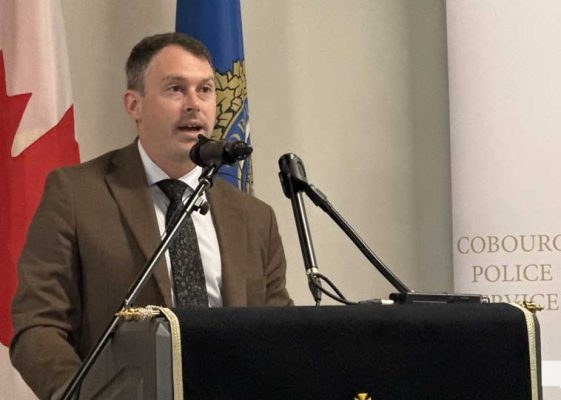
Cobourg Police are drawing a line in the sand.
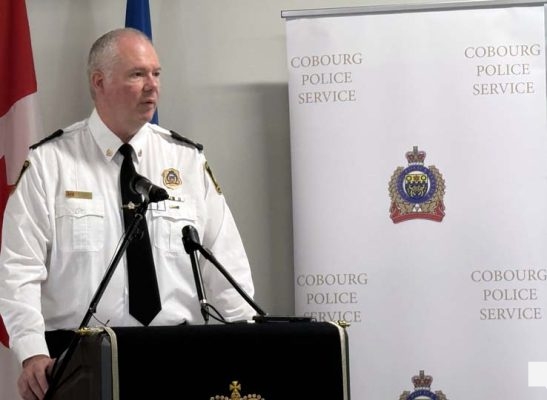
After years of dealing with the same people, the same problems and the same calls in the same public spaces, Chief Chris Leather says the police service and the Town of Cobourg are taking a much harder and more coordinated approach to repeat disorder.
And the numbers presented Tuesday are staggering.
Five prolific offenders alone generated 919 calls for service in 2025, accounting for nearly five per cent of every call received by Cobourg Police that year.
Police officers spent 815 hours dealing with those five individuals.
There were 42 arrests and 52 charges, at an estimated direct police salary cost of $42,510.
And that doesn’t include court costs, administrative costs or the broader cost to the community.
Leather unveiled the new approach Tuesday morning during a press conference at Venture13, joined by Town Clerk Brent Larmer, who presented the Town’s own enforcement numbers.
The message from both was blunt:
The status quo isn’t working.
“It’s about restoring order,” Leather said. “It’s about balancing support with accountability, and it’s about addressing repeat harm more effectively.”
The press conference had originally been scheduled for August 21 but was postponed until Tuesday.
One person generated 287 calls
The police assessment looked specifically at five individuals who were considered prolific offenders.
One person alone was associated with 287 calls for service.
Another individual generated fewer calls but consumed the greatest amount of police resources and had the highest estimated direct salary cost.
Leather said unwanted-person calls were the predominant call type involving four of the five people.
That is significant because it demonstrates that a massive amount of police time is being consumed by incidents that aren’t necessarily criminal.
“Not all high-frequency demand is criminal in nature,” Leather said.
Some calls involve criminal offences, public disorder, victimization or threats to public safety.
Others involve mental-health crises, addiction or homelessness.
And sometimes all of those issues are wrapped into the same situation.
But Leather said that doesn’t mean police should simply continue responding to the same person, at the same location, for the same behaviour over and over again.
“If we continue to respond to each occurrence in isolation, without considering the broader pattern, we should not expect different outcomes,” he said.
‘We can be compassionate without being permissive’
Leather was careful to say police aren’t pretending they can solve homelessness, addiction, mental illness or poverty.
“Police are not the solution to homelessness, addiction, mental-health challenges, or poverty,” he said.
Those problems require health-care providers, housing agencies, addiction and mental-health services, social-service agencies and community organizations.
But Leather also delivered a strong message to people who repeatedly create problems in public spaces.
“Compassion does not mean ignoring disorder or harmful behaviour in public spaces,” he said.
And perhaps most pointedly:
“We can be compassionate without being permissive.”
Leather said the new strategy will focus on behaviour — not status.
A person needing help will continue to be offered help where appropriate.
But that doesn’t give someone the right to repeatedly intimidate residents, victimize businesses, create disorder or prevent others from safely using public spaces.
43 arrests since July
The Chief said the new strategy is already underway.
Since July, targeted police activity has resulted in 43 arrests and 11 charges or Provincial Offence Notices under the Liquor Licence and Control Act.
Uniform officers, the Street Crime Enforcement Unit and the Criminal Investigations Bureau are involved in targeted initiatives.
Police are also conducting proactive patrols, property checks, bail-compliance checks and targeted enforcement.
The effort is not replacing investigations into drug trafficking, organized crime and other serious offences.
Instead, Leather said the service is trying to deal with the recurring problems that continue to consume police resources and affect public spaces.
A recent example came August 13 when targeted enforcement was conducted downtown following concerns involving open-air drug use, possession and trafficking.
Nine adults were arrested and Schedule 1 substances were seized.
Town says it is also stepping up
Cobourg’s Municipal Law Enforcement team is now working hand-in-hand with police.
Larmer provided a sobering look at the Town’s enforcement workload.
Since January 1, 2025, Municipal Law Enforcement has responded to 3,148 calls for service.
Of those, 595 — or 19 per cent — involved nuisance-type concerns, including encampments, general patrols, noise, parks enforcement, public nuisance and trespassing.
The Town has issued:
50 trespass notices
73 Administrative Monetary Penalties
And approximately 600 officer hours have been dedicated to these types of enforcement efforts.
Larmer said those efforts represent approximately $26,000 in annual staff costs being diverted from other enforcement responsibilities.
Downtown is a major hotspot
The Town received 217 Municipal Law Enforcement calls in July alone.
The top categories were animal control, parks, encampments, lot maintenance and parking.
Only about five per cent of the calls were directly inside the formal DBIA boundary.
But when the broader downtown area was considered, the number jumped to 32 per cent of all calls.
Those calls were concentrated around parks, encampments, general patrols and public nuisance complaints.
There were also 39 non-parking administrative penalties issued.
Twenty-five were issued downtown.
And 76 per cent of those downtown penalties were related to public nuisance violations.
Trinity area under the microscope
Municipal Law Enforcement is also paying particular attention to the area surrounding the Trinity Parking Lot, including James, John and Chapel Streets and extending south toward King Street.
Officials say concerns include blocked sidewalks, bicycles, skateboards and scooters being operated on sidewalks, public consumption of alcohol and drugs, public urination and defecation, animal-control problems, loitering and litter.
Officers are conducting patrols during the day, afternoon and overnight.
Security guards deal with 217 incidents
The Town also released information about its new contracted security program, which has been operating for just over a month.
Security guards recorded 217 incidents during their first month.
Of those, 175 were classified as minor, 34 as significant and eight as critical.
The critical incidents included medical episodes, thefts, fires and intoxication.
But the number that jumps out is this:
77 per cent of all incidents involved trespassing or people being escorted from property.
Another 15 per cent involved public intoxication or drug use, vandalism or property damage and littering.
Victoria Park, the Marina, Ecology Park and the East Pier were among the locations with the highest concentration of incidents.
Town declares ‘zero tolerance’
Larmer didn’t mince words when describing the Town’s new approach.
Municipal Law Enforcement is taking a “zero-tolerance approach” to repetitive nuisance behaviour in parks and open spaces.
The Town says officers will prioritize calls based on reported nuisance activity and direct resources toward areas where residents are reporting the greatest problems.
The police and Town also stressed that residents need to report problems.
Municipal Law Enforcement can be reached 24 hours a day, seven days a week, at 905-372-8380, or through the Town’s Report It system.
More than policing
Despite the tougher language, Leather said enforcement alone won’t solve Cobourg’s problems.
Police are now looking to bring health, housing, addiction, mental-health, social-service and community organizations into the strategy.
The objective is to determine who is responsible for what — and ensure people are connected with the appropriate services.
But Leather emphasized that doesn’t mean waiting for another committee, another study or another meeting.
“Police and Municipal Law Enforcement are working together now,” he said.
“We are using the tools currently available to us now.”
For residents and business owners who have complained about recurring disorder in parks, downtown and along the waterfront, Tuesday’s announcement represents a significant shift in tone.
For years, the response to many of these situations has involved police attending, dealing with the immediate problem and moving on.
Now, Leather says police are going to look at the bigger picture.
Who keeps coming back?
Where are they going?
What are they doing?
How many times have police been called?
What resources are being consumed?
And what combination of enforcement, municipal action and social services can actually break the cycle?
Leather said residents should be able to walk downtown, take their children to parks, operate businesses and enjoy Cobourg’s public spaces without repeatedly encountering disorder, intimidation or unlawful behaviour.
“Everyone should be able to do that,” Leather said.
“That is what restoring order looks like.”
And for Cobourg, the real test will now be whether the new strategy produces something the community has been asking for:
Less disorder. Fewer repeat calls. And public spaces that residents feel comfortable using again.

Author: Pete Fisher
Has been a photojournalist for over 30-years and have been honoured to win numerous awards for photography and writing over the years. Best selling author for the book Highway of Heroes - True Patriot Love