

A bird that is often misunderstood, sometimes feared and rarely given much credit will be taking centre stage in Port Hope next weekend.
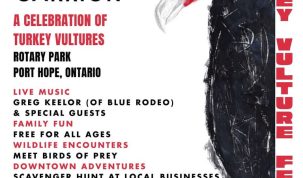
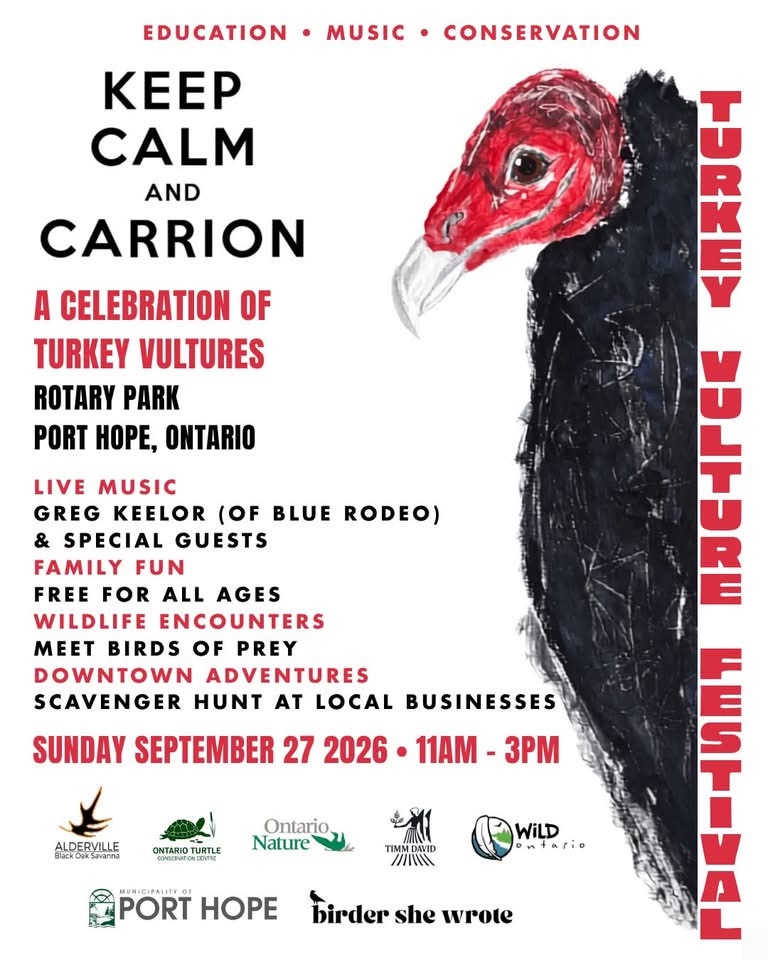
The Turkey Vulture Festival will take place Sunday, September 27, from 11 a.m. to 3 p.m., bringing together education, conservation, music, wildlife and family activities for a celebration of one of nature’s most important cleanup crews.
The event is being organized by Caolaidhe Keelor, who describes herself as a “public relations representative” for turkey vultures and hopes the festival will change the way people see the large birds.
“I am very excited to have Port Hope’s very first turkey vulture festival,” Keelor said. “I believe it’s Canada’s very first turkey vulture festival and it is a celebration of vultures and turkey vultures in particular.”
Keelor says one of the main goals is to correct what she considers widespread misconceptions about the birds.
“There’s a lot of misconceptions about the vulture and I’m here to clean them up,” she said.
One of the biggest misconceptions, she says, is that turkey vultures are predators.
“They don’t see anything living as food. So, they are only eating what’s already dead,” Keelor explained. “They’re not going to take your pets and they don’t want to harm you.”
Instead, she calls them “nature’s cleanup crew.”
Turkey vultures play an important role in the environment by consuming carcasses that could otherwise contribute to the spread of disease.
Keelor points to the birds’ remarkable digestive systems as one reason they are so effective.
“The acidity in their stomach is equivalent to that of battery acid,” she said, explaining that their stomach acid can reach a pH of approximately 0.5 to 1.
“When they eat pathogens like rabies or any harmful bacteria that might be on carcasses, when they consume it, they’re recycling it and it comes out clean,” she said.
“So vultures actually stop the spread of disease and so they’re a keystone species to the environment.”
The festival will feature a conservation village with a number of environmental organizations and wildlife groups.
Among those expected to take part are Ontario Nature, Ontario Turtle Conservation, Wild Ontario with birds of prey and Ducks Unlimited.
An opening ceremony from Alderville First Nation will also be part of the day.
And then there will be music.
The lineup includes Greg Keelor of Blue Rodeo, along with Matt Mays, Travis Good of The Sadies and Jimmy Bowskill, with additional musicians potentially being added.
For Keelor, however, the music is only one part of a larger effort to educate people about vultures and conservation.
“I feel the more you know about something, the more you want to protect it,” she said.
While turkey vulture populations remain relatively healthy across North America, Keelor says other vulture species around the world are experiencing serious declines.
“A lot of other vultures are critically endangered. A lot of them are quickly declining in population and that affects us. It doesn’t just affect the vultures but it will affect humans as well.”
Keelor admits that popular culture hasn’t exactly helped the turkey vulture’s reputation.
Vultures are often portrayed as ominous, spooky or sinister birds.
In reality, she says, many of their behaviours are simply misunderstood.
When a turkey vulture stands with its wings spread wide, sometimes called the “heraldic pose,” it isn’t preparing to attack.
“When you see a vulture with its six-foot wingspan spread out, that’s the heraldic pose,” Keelor said. “That’s them warming up their bodies.”
The birds also use the sun’s ultraviolet light as part of the process of reducing bacteria they may have picked up.
And then there is the bald head.
“People think they’re ugly and that gives me that hurts my feelings when people say they’re ugly,” Keelor joked.
“That little bald head is just the art of evolution. And when they’re sticking that little face in carcasses, they don’t want to get blood or guts all over it. So having a nice bald head keeps them clean.”
Keelor’s own fascination with vultures began while working with Pacific Northwest Raptors on Vancouver Island.
“I am a bird nerd through and through,” she said.
While working there, she became particularly attached to a turkey vulture named Judge Dread.
“I fell in love with him. He was an amazing bird. He is an amazing bird,” she said. “He’s still alive. I just don’t see him as often.”
That experience changed how she viewed vultures.
“And the more I learned about him, the more I loved vultures.”
When she eventually moved to Port Hope in September, the timing happened to coincide with the beginning of the birds’ fall migration.
“I arrived and there were hundreds of turkey vultures in the trees and so I knew that I had made the right stop.”
Port Hope’s turkey vultures are also particularly noticeable during the annual salmon run along the Ganaraska River.
“The reason they hang along the Ganaraska River is because it’s during the salmon run,” Keelor explained. “So all the salmon are dying and so that’s easy feeding for them.”
They can also frequently be spotted along roadways, where roadkill provides another source of food.
And if you see vultures circling high overhead, Keelor says they aren’t necessarily waiting for something to die.
They’re simply taking advantage of nature’s free transportation system.
“When you do see vultures therming in the sky and circling above, it’s not necessarily that they’re waiting for something to die,” she said. “It’s that they’re catching the updraft from the thermals. So it’s just them catching a free ride.”
The September 27 festival will offer plenty of opportunities for people to see the birds up close and learn more about them.
A scavenger hunt will take participants through downtown Port Hope businesses from 11 a.m. to 2 p.m., while birds of prey will be on display in Rotary Park from 11 a.m. to 2 p.m.
The Alderville First Nation ceremony is scheduled for approximately 1 p.m., followed by live music beginning around 2 p.m.
There will also be a Vulture Art Gallery at Tim David Café from 10 a.m. to 5 p.m.
For Keelor, the hope is that people leave the festival seeing turkey vultures a little differently.
Perhaps the next time one is spotted soaring above Port Hope or perched along the Ganaraska River, it won’t be viewed as something ominous.
It will simply be recognized for what it is — an important part of the natural world doing a very dirty, but very necessary, job.

Author: Pete Fisher
Has been a photojournalist for over 30-years and have been honoured to win numerous awards for photography and writing over the years. Best selling author for the book Highway of Heroes - True Patriot Love