

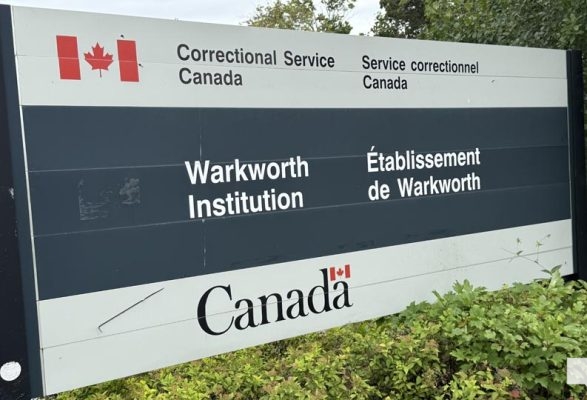
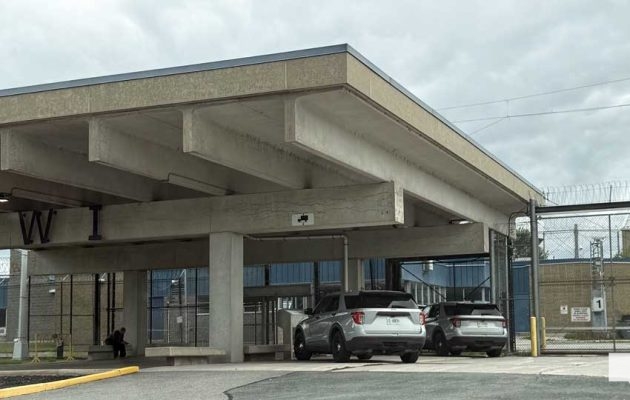
Correctional officers at Warkworth Institution are questioning what they call a troubling contradiction — members of the public are being directed onto federal prison property to surrender firearms while the same institution is facing planned staffing cuts that the union says could weaken security.
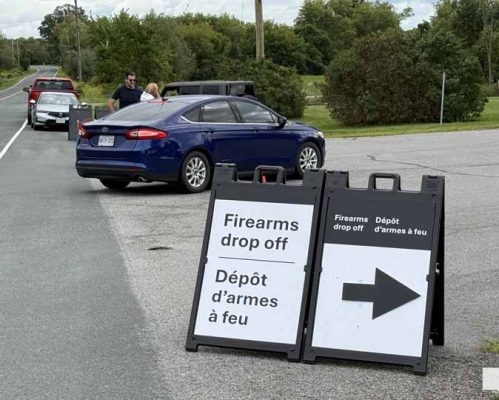
Tyler McMurray, president of the local union representing more than 200 correctional officers at Warkworth Institution, was outside the prison Tuesday as RCMP officers collected firearms from individuals participating in the federal government’s Assault-Style Firearms Compensation Program.
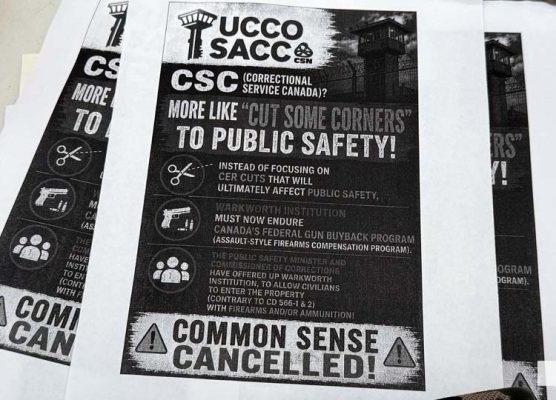
Union members were handing pamphlets to motorists entering the institution, warning about what they describe as cuts to correctional staffing and public safety.
The pamphlet distributed by the union declares that Correctional Service Canada is “cutting corners on public safety” and questions the decision to allow civilians onto federal prison property with firearms and ammunition.
Across the top, it carries a blunt message:
“Common Sense Cancelled.”
McMurray said the union has questioned both the location of the firearms collection and the planned staffing reductions with the Commissioner of Correctional Service Canada and the federal Public Safety Minister.
“We’re questioning why the RCMP would have a drop-off on a federal institution with firearms,” McMurray said.
According to information obtained by Today’s Northumberland, more than 200 firearms were turned in at Warkworth Institution Tuesday, with the average compensation reportedly around $1,000 per firearm.
Public Safety Canada wouldn’t confirm, but it’s believed this is the only correctional facility this program is taking place in Canada.
Some eligible firearms under the federal program can result in compensation approaching $2,000, depending on the firearm.
Public Safety Canada says the program was created to give eligible owners of prohibited assault-style firearms a way to comply with the law.
A spokesperson for Public Safety Canada told Today’s Northumberland that more than 2,500 makes and models of assault-style firearms have been prohibited since May 2020.
The federal department says only owners who declared their prohibited firearms during the national declaration period and whose declarations were approved can participate in the collection and compensation process.
The government says firearms are collected by the RCMP, participating local police services or secure mobile collection units, depending on the region.
Public Safety Canada also said mobile collection units can operate at secure locations, including locations provided through partnerships with federal departments and agencies.
For security reasons, the government does not publicly disclose the locations of mobile collection units. Participants are informed of their collection location after booking an appointment.
But McMurray says the issue at Warkworth is not with the RCMP officers carrying out the program.
“Nothing against the RCMP,” he said. “I think they’re doing it very safely. I think they’re doing a great job doing it. Again, it is just it’s on a federal institution property where we encourage offenders not to have weapons.”
He said that is what makes the situation difficult for correctional officers to understand.
“You’re not allowed to bring contraband or unauthorized items onto the federal institution’s property,” McMurray said. “But our commissioner seems to think that, I guess, the commissioner’s directives don’t apply to him.”
McMurray said people arriving for their appointments have also expressed surprise that they are being directed to a federal prison to surrender firearms.
“Every person that has dropped off their firearm today has said, ‘I can’t believe I’m coming to a federal institution to drop off a firearm,’” he said.
The firearms collection is taking place throughout the week, with a scheduled break Monday before continuing until September 3.
McMurray said individuals have scheduled appointments and are arriving at intervals of roughly 10 minutes, with RCMP officers handling the collection inside the institution.
But while the firearms program drew the union members outside the prison gates, McMurray said their bigger concern is what he describes as an erosion of security at Warkworth.
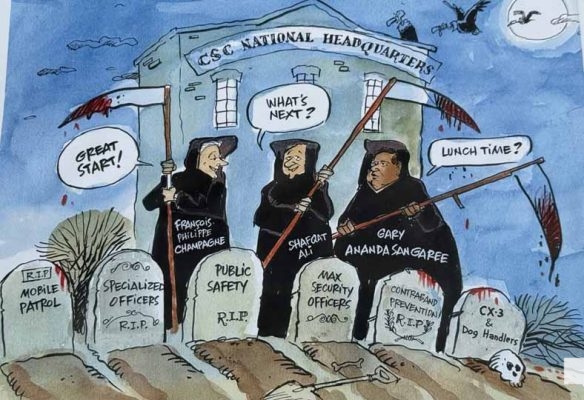
He said Correctional Service Canada is implementing a workforce adjustment plan that will eliminate correctional officer positions and posts.
One of the posts the union is particularly concerned about is a mobile patrol that monitors the institution’s perimeter.
The union says the timing is particularly concerning because drones are already a significant problem at Warkworth.
McMurray said drones regularly fly over the institution and drop contraband into the prison.
That contraband, he said, can include tobacco, illicit drugs and weapons.
He said some weapons can be particularly difficult to detect.
“We have drones flying in, dropping contraband, anywhere from unauthorized items such as tobacco to illicit drugs to weapons as far as stuff like ceramic knives that won’t be detected by our metal detectors,” he said.
McMurray said Warkworth now houses more than 600 inmates and has a significant population of gang-affiliated offenders.
“We’re coming into a very dangerous environment,” he said.
He said the proposed staffing reductions will only add to the pressure on correctional officers.
“We’ve had numerous officers assaulted recently,” McMurray said. “We’ve had inmate fights every day. The reality is prison is a dangerous place and we’re hoping the CSC sees that.”
According to McMurray, the cuts began moving forward around April, with implementation expected this fall.
The union is fighting to prevent the elimination of the positions, arguing that the posts are necessary for the security of the institution.
“They’re essential to keep the inmates safe,” he said. “They’re essential to keep the public safe and they’re essential to keep us safe as correctional officers.”
For officers who work inside Warkworth every day, McMurray said the issue goes well beyond staffing numbers.
“Every day correctional officers go into this institution and they essentially want to go in, they want to protect the public,” he said. “That is our main goal — is protect the public, protect the inmates — but we also want to be safe when we’re doing that as well.”
He warned that reducing perimeter patrols could make it more difficult to deal with drones, unauthorized access and other security threats.
“We can’t afford to have more drone attacks every day,” McMurray said. “We can’t afford to have more inmate assaults, more officer assaults.”
McMurray is urging members of the public who are concerned about the proposed cuts to contact their elected representatives.
He specifically pointed to Northumberland-Peterborough South MP Philip Lawrence.
“I would recommend they call their local MP,” McMurray said. “Philip Lawrence is ours in Northumberland County. He has been amazing to deal with.”
He also encouraged residents to contact the Commissioner of Correctional Service Canada and ask why posts are being eliminated at a facility the union says is already facing significant security challenges.
For McMurray and the correctional officers outside Warkworth Institution Tuesday, the firearms collection became a highly visible symbol of what they believe is a much larger problem.
On one side of the prison gates, members of the public were arriving with firearms to participate in a federal government compensation program.
On the other, correctional officers were warning the public that the institution is preparing to lose positions responsible for maintaining security.
McMurray said the union believes those two issues raise an obvious question: why is the federal government increasing activity involving firearms at a correctional facility while simultaneously reducing the staffing intended to keep that facility secure?
The firearms collection program is scheduled to continue at Warkworth through September 3, while the union says the staffing reductions are expected to begin being implemented this fall.

Author: Pete Fisher
Has been a photojournalist for over 30-years and have been honoured to win numerous awards for photography and writing over the years. Best selling author for the book Highway of Heroes - True Patriot Love