Video – National Silver Cross Mother Also Served with Distinction
By Cecilia Nasmith/Today’s Northumberland
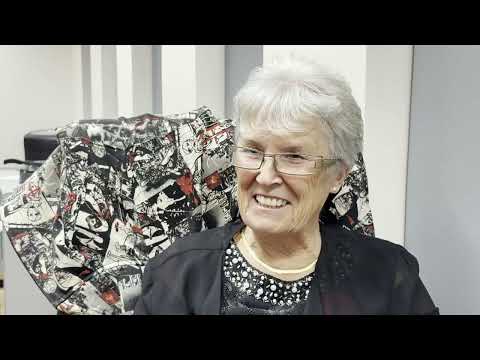
The Royal Canadian Legion Branch 133 in Cobourg had a special visitor Monday night – the newly announced 2026 Silver Cross Mother, Virginia Hicks of Frankford.
The honour had only been announced the day before, meaning Hicks will do the honours of placing a wreath at the National War Memorial in the nation’s capital on Remembrance Day, representing all Canadian mothers and families who have lost a son or daughter in the line of service.
She has also learned that she is the only National Silver Cross recipient who had served in uniform, who lost a child.
Though referred to as the Silver Cross, its proper name is the Memorial Cross. It was introduced Dec. 1, 1919, as a symbol of personal loss and sacrifice on behalf of widows and mothers who lost a child on active duty, or whose death is later attributed to such duty.
In this case, it was Hicks’s daughter, Sapper Mariebeth Short, who served with Petawawa’s 2 Combat Engineering Regiment.
Born Jan. 23, 1980, in Comox, BC, she grew up in a family steeped in the military tradition – including both parents in the Royal Canadian Air Force. She died Sept. 23, 2002, during a training exercise on the Matawa Plains.
“Mariebeth was 22, 4’11”, 95 lb.,” her mother said in an interview with Today’s Northumberland.
“She decided in Grade 12 she wanted to try her hand at doing different things – retail, picking apples in the Annapolis Valley.”
Then one of her friends pointed out that the Canadian Forces were recruiting people.
“She decided, ‘This is what I want to do because Mom and Dad are in the military. We have seen a lot of places, we have been a lot of places.’
“She wanted to be able to travel, she wanted to see the world and get a trade.”
Short entered basic training in January 2000 at St. Jean, which she completed successfully, then on to Gagetown to begin training as a combat engineer.
“Someone who is 4’11’, 95 lb. – doing combat engineering work is a little bit dicey, and she had to prove herself to her instructors. And when she finally graduated, it was second in her class by one-half per cent,” Hicks recalled with a mother’s pride.
Short got a posting at CFB Petawawa with the 23 Field Squadron. There, she became involved in trials for new bomb suits, and Hicks noted that there’s an on-line video of her walking around in one. It’s quite a sight, because Short was in the 95th percentile for her size – “meaning 95% of the people were bigger,” Hicks said.
“She thoroughly enjoyed her trade. She loved doing all kinds of different things – build bridges, mine detecting, she had just finished a two-month training scenario for looking after and maintaining and driving the LAV 3, the new LAV [light armoured vehicle].”
The Monday Short was finishing up this project, she called her mother at work to let her know, and said she would call back after the exercise.
Hicks took the call in Halifax, where she and her husband Brian had just moved from Greenwood, NS.
Later that day, she was in the kitchen preparing their dinner when her husband asked her if she were on duty because he saw a military vehicle pull into their driveway. When it stopped and the door opened, he spotted crosses and realized it was a padre.
He came to the door and asked for Master Corporal Virginia Hicks.
“He said, ‘No, not before you talk to me,’” she recalled.
The padre said he had to inform her that her daughter had been killed that day on the Matawa Plains – whereupon her husband punched the house and actually moved a brick.
They called Hicks out of the kitchen, and her first thought was that there was a problem with her parents or possibly parents-in-law – both her dad and her father-in-law were military. Both were travelling and it had been agreed, if anything happened, they’d make contact through the padre’s office. Then he spoke.
“He said, ‘I’m very sorry to inform you but your daughter was killed today on the Matawa Plains.’ I looked at him and told him he was a liar – I’d just spoken to her that morning.”
The padre got on the phone to arrange transportation to Ottawa, experiencing considerable difficulty and actually swearing at one point. But he managed to get the two seats they needed, and they eventually arrived at CFB Petawawa.
“They were very sorrowful about Mariebeth passing. They explained what they knew at the time – it wasn’t very much. She was currently at the coroner’s office in Pembroke for the autopsy,” Hicks related.
The LAV had been new, with no more than 21 km. on it. They were still trying to figure out how it worked.
The parents were allowed to speak with the two crew members who had been with her in the vehicle.
When Mariebeth had taken a turn driving, she was so short she had to stand on the gunner’s chair to see out of the vehicle.
The LAV encountered an old army trench that had been filled in with loose sand. The front left wheel hit it and literally snapped off. The other three wheels rolled over it and the vehicle rolled.
When the crew realized what was happening, they tried to pull Mariebeth back inside, but the pockets and tabs of her tactical vest caught on the machinery. She was on the outside of the LAV when the 18-ton machine rolled twice and came to rest on its side.
“The investigation found there was a substandard weld in the left wheel assembly that holds the tie rods together,” Hicks said. Hitting the trench made the tie rod come apart. It was determined to be a manufacturer’s defect that did not meet contract specifications.
Mariebeth is now buried in Trenton. Her military funeral was attended by 750 service members.
Hicks admits that she and her husband seriously considered leaving their careers after their loss.
“It took us about two years to decide whether or not we were going to stay in. We weren’t getting answers from anybody. Over that two-year period, my husband and I really thought, ‘Do we stay or do we go?” It took a lot of counselling and a lot of internal fortitude to say, ‘Okay, she liked her job – no, she loved her job.’”
She knew the risks when she signed on, they reasoned, as does everyone who serves. And in the end, Hicks did 29 years and her husband did 30. Both leave behind extensive records of service, both domestic and overseas.
Each year, nominations for the Silver Cross honour are made to the Royal Canadian Legion from Provincial Commands and individual Canadians. A Dominion Command selection committee awards the designation.
Hicks revealed that she was actually approached by Dominion Command in June, “asking me if I would do them the honour of being the Silver Cross Mother. They told me not to say anything – they are the ones who have to announce it.”
There is a team in constant communications with Hicks for any thing – or any guidance – she needs, but one thing that surprised her is that the Silver Star designation can go to the family of a service member who died during domestic service as opposed to in a combat situation abroad.
Asked how Mariebeth would feel about her being the Silver Cross Mother, Hicks replied, “I hope she would be very proud of me.
“There’s always risks involved, and you always hope your child or your husband or your wife always has the best protections to keep safe.”
On Nov. 11, she will be thinking of her daughter.
“Also, the other mothers, fathers, brothers and sisters who have lost loved ones in the service of Canada – not only in the theatre of war, but when they are in Canada training.”
Between her receiving news of the honour in June and her announcement a few days ago, the tragedy of four young lives lost in a training exercise at CFB Wainwright in Alberta has shaken Canadians, and resonated deeply with Hicks.
“When I received my Silver Cross, or the Memorial Cross, I wasn’t even aware it was given to members of the military whose family died in the service of Canada in Canada. I always assumed it was people overseas. For me, it was a bit of a surprise. Now I understand more, I am very sad to see we now have four more families who are joining a club that nobody wants to be a part of,” she said.
If she had a message for the affected families, it would be to counsel patience as the military conducts its investigation.
“Once they know, they will let you know what happened and how they are going to fix it, how they are not going to let it happen again,” she said.
“They will all know exactly what happened, and there will be no guessing.”
Looking ahead, Hicks has had the opportunity to speak with her predecessor.
“She said, ‘You are as busy as you want to be.’”
As far as Hicks is concerned, that’s pretty busy. Her Today’s Northumberland interview took place the night before she was to leave for Ottawa and an itinerary that included two galas, a Senators hockey game, meetings with different press people, the big Remembrance Day observances, meetings with the Governor General and the Minister of Veterans Affairs, a tour of the War Museum, several luncheons – “and that’s only until the twelfth,” she pointed out.
Her appointment runs through Oct. 31 next year. In the interim, she might literally be doing her duty anywhere in Canada.
“I am willing to go wherever people want me to go,” she stated.
“They have asked me to think about something I would like to impress on the Canadian public,” she added – and she definitely has an idea.
Hicks has been inspired by the memorial banners appearing in many communities, including Cobourg, to honour the service of a local individual in the days leading up to Remembrance Day. But the banners are only up for a couple of weeks.
“A lot of the younger generation don’t understand what the older generations went through,” she said.
She believes an excellent school project would be to adopt one of these local heroes and create a biography. Research the person, his or her childhood years and those years leading up to his or her military service. Research that service, where it took place, whether he or she ever came home – and, if so, what post-war life was like for this person. Make these heroes real for a new generation.
“They might be surprised what they learn,” she predicted.

